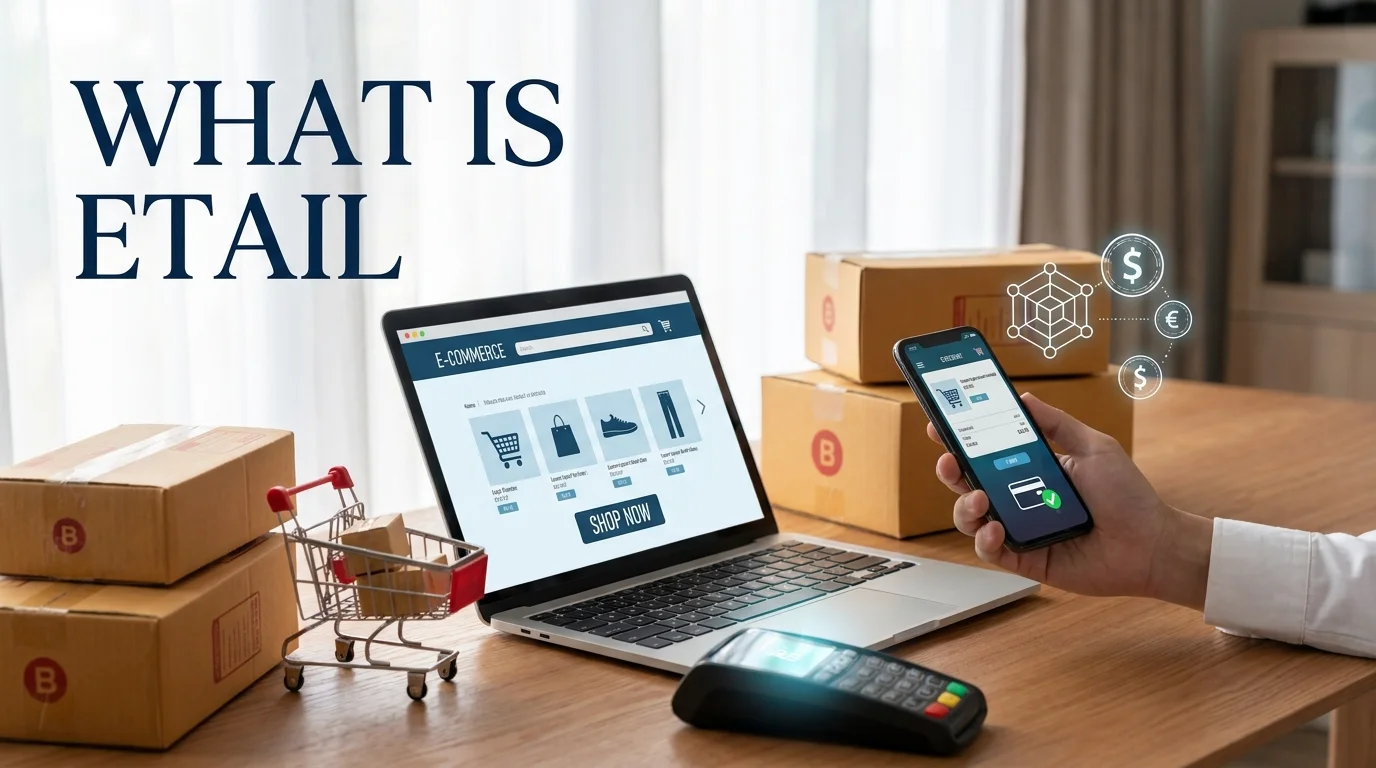
If you have searched “what is etail,” the simplest answer is online retailing: buying and selling retail products through the internet instead of in a physical store. E-tail now covers everything from shopping on a retailer’s website to purchasing through an online marketplace, mobile app, or social platform. For U.S. shoppers, it has become an ordinary part of how products are discovered, compared, purchased, delivered, and returned.
Short answer: Etail, short for electronic retailing, is the sale of retail products or services through the internet. Customers browse, compare, order, and pay through websites, apps, marketplaces, or social platforms instead of completing the purchase in a physical store. E-tail is generally considered a retail-focused part of the broader e-commerce ecosystem.
Key Takeaways
- Etail means electronic retailing and generally refers to retail sales completed online.
- E-tail can happen through retailer websites, apps, online marketplaces, and social-commerce platforms.
- E-tail is part of e-commerce, but e-commerce is a broader term covering more types of online commercial activity.
- Pure-play e-tailers sell primarily online, while brick-and-click retailers combine online and physical stores.
- E-tailing gives shoppers greater convenience and product access but creates challenges involving shipping, returns, cybersecurity, and customer trust.
- U.S. retail e-commerce accounted for 17.1% of total retail sales in the second quarter of 2026.
What Is Etail, Exactly?
E-tail is a shortened form of electronic retailing or e-retailing, and dictionaries define it as retail business conducted through the internet. An e-tailer is therefore a business or seller that offers retail products to customers through an online channel. The terms e-tail, etail, e-tailing, electronic retailing, and online retailing are often used interchangeably.
The defining feature is not whether the company owns warehouses, stores, or inventory, but where the customer completes the retail transaction. A traditional retailer can become an e-tailer by allowing customers to browse products and place orders through its website or app. A company can also operate entirely online without maintaining customer-facing stores.
For example, a shopper who orders pet food from an online store is participating in e-tail. A customer who visits a major retailer’s website, pays online, and chooses home delivery or store pickup is also using an e-tail channel. In both cases, digital technology is handling the retail transaction that once would have required a visit to a physical checkout counter.
How Does E-Tailing Work?
E-tailing turns the major stages of the retail buying process into a digital experience. Instead of walking through aisles and taking products to a register, shoppers use digital product pages, search tools, shopping carts, payment systems, and delivery options. Behind that experience, retailers still need inventory management, fulfillment, customer service, marketing, and returns processes.
A typical e-tail transaction works like this:
- A retailer creates a digital storefront. Products are listed on a website, app, marketplace, or social-commerce channel.
- The customer searches or browses. Product descriptions, images, specifications, prices, ratings, and reviews help the shopper compare options.
- The customer adds products to a cart. The platform records the selected products, quantities, discounts, and estimated costs.
- The shopper checks out. Shipping or pickup details are entered and payment is processed electronically.
- The retailer fulfills the order. The business, warehouse, marketplace partner, or third-party supplier prepares the purchase.
- The order reaches the customer. Goods may be shipped to a home, sent to another delivery location, or prepared for store pickup.
- After-sales service begins. Retailers manage tracking, questions, refunds, exchanges, reviews, and customer retention.
The customer sees only part of this system, while much of the work takes place behind the website or app. Inventory has to remain accurate, payment information must be handled securely, and orders need to reach the right customer on time. This is why successful online retail depends as much on logistics and operations as it does on an attractive storefront.
What Are the Main Types of E-Tailers?
E-tailers can be organized in several ways, but two traditional categories are pure-play e-tailers and brick-and-click retailers. Modern online selling has also created marketplace, direct-to-consumer, subscription, and social-commerce models that overlap with those classifications. The right label depends on how a business reaches customers and whether it also operates physical retail locations.
| E-Tail Model | How It Works | Familiar Example |
|---|---|---|
| Pure-play e-tailer | Sells primarily through online channels rather than customer-facing retail stores | Chewy or Wayfair |
| Brick-and-click retailer | Combines physical stores with online purchasing | Walmart or Target |
| Online marketplace | Provides a platform where multiple sellers offer products | Amazon Marketplace, Etsy, or eBay |
| Direct-to-consumer | A brand sells its own products directly through its website or app | A clothing, beauty, or specialty brand store |
| Subscription e-tail | Products are delivered on a recurring schedule | Meal, beauty, or household subscription services |
| Social commerce | Products can be discovered and purchased through social platforms | Shops and shoppable posts on social apps |
Pure-Play E-Tailers
A pure-play e-tailer builds its retail operation primarily around internet sales rather than a nationwide network of customer-facing stores. This model can reduce some traditional storefront expenses and make it easier to serve customers across a wider geographic area. However, the retailer still has high costs for technology, warehousing, shipping, customer acquisition, returns, and support.
Brick-and-Click Retailers
Brick-and-click companies combine physical stores with an online retail operation. A customer might inspect an item in a store and order it online later, or place an order digitally and pick it up at a nearby location. This approach lets retailers combine the convenience of e-tail with the immediate access and physical experience of traditional shopping.
Marketplaces and Other Digital Models
Marketplaces such as Amazon, Etsy, and eBay bring many individual sellers together on one digital platform. Other businesses use subscriptions, their own direct-to-consumer websites, or social-commerce tools to generate online retail sales. Shopify identifies online stores, marketplaces, subscriptions, social commerce, and auction sites among the models that can support e-tailing.
Etail vs. E-Commerce: What Is the Difference?
Etail and e-commerce overlap, but they don’t always mean exactly the same thing. E-tail focuses specifically on retail selling through digital channels, while e-commerce can describe a much broader range of commercial transactions conducted electronically. Shopify, for example, describes e-tailing as a retail-focused subset of e-commerce.
| Term | Main Meaning | Typical Example |
|---|---|---|
| Etail | Selling retail products to customers online | Buying shoes from a retailer’s website |
| E-commerce | Broader electronic commercial activity | Online retail, B2B transactions, digital payments, or online services |
| Traditional retail | Retail transactions centered on physical stores | Buying shoes at a shopping mall |
| Omnichannel retail | Connected online and offline shopping experiences | Order online and pick up in store |
The terminology is not completely rigid, and some business resources use e-tailing broadly enough to include certain business-to-business transactions. For everyday consumers and retailers, however, e-tail most commonly describes the online retail portion of e-commerce. That distinction is useful because not every electronic business transaction is a retail sale.
What Are the Benefits of E-Tailing for Consumers?

The biggest advantage for shoppers is convenience. Customers can research and purchase products outside normal store hours without traveling to a retail location. Online stores also make it easier to compare several products, retailers, prices, specifications, and customer reviews before deciding what to buy.
Common consumer benefits include the following.
- 24/7 access to shopping
- Wider product selection
- Easy price comparison
- Access to customer reviews and ratings
- Home delivery
- Digital order tracking
- Convenient reordering
- Access to stores outside a customer’s local area
- Pickup and delivery choices from omnichannel retailers
E-tail can be particularly useful for people who live far from major shopping areas or need products that are difficult to find locally. It also gives consumers more control over preliminary product research because specifications and alternatives can be compared without moving between physical stores. The tradeoff is that shoppers cannot always touch, test, try on, or physically inspect merchandise before buying it.
What Are the Benefits of E-Tailing for Businesses?
For retailers, selling online can extend a business’s geographic reach beyond the traffic that passes a physical location. An e-tail store can remain available around the clock and can potentially serve customers in many states without opening a storefront in each market. Digital channels also generate useful information about customer behavior, popular products, conversion rates, and purchasing patterns.
Business advantages can include the following.
- Access to customers beyond a local market
- Fewer geographic limitations
- 24-hour product availability
- Easier product-catalog expansion
- Measurable customer and sales data
- Personalized recommendations and promotions
- Easier integration with digital advertising and content marketing
- Scalability through warehouses and fulfillment partners
- Automation of inventory, order, and customer-service processes
Lower physical-store costs do not mean that e-tailing is inexpensive to operate. Businesses may exchange expenses such as premium retail rent for spending on software, fulfillment, advertising, cybersecurity, warehousing, and returns. An effective online retailer therefore needs to manage both customer acquisition and operational efficiency rather than assuming that moving sales online automatically produces higher margins.
What Are the Disadvantages of E-Tailing?
E-tailing solves several problems associated with physical shopping, but it creates a different set of challenges. Products have to travel between businesses and customers, websites must remain secure and reliable, and buyers need enough information to purchase without physically examining merchandise. Returns can also become expensive and inconvenient for both sides of the transaction.
Major e-tail challenges include the following.
- Shipping costs and delivery delays
- Product returns and exchanges
- Customers being unable to inspect products physically
- Cybersecurity and payment-fraud risks
- Data privacy responsibilities
- Dependence on websites, apps, and other technology
- Competition for online visibility
- Digital advertising and customer-acquisition costs
- Inventory synchronization problems
- Customer-service expectations
- Dependence on marketplace rules for third-party sellers
Trust matters especially because customers can’t rely on a store’s physical environment when deciding whether to buy. Clear product descriptions, accurate photographs, secure payments, transparent shipping information, and straightforward return policies can reduce that uncertainty. Reliable fulfillment then determines whether the digital promise made at checkout becomes a satisfactory real-world experience.
Examples of E-Tail in Everyday Life
Most Americans already interact with e-tail regularly, even if they never use the term. Ordering electronics from a retailer’s app, buying handmade goods through a marketplace, scheduling a recurring shipment of household products, or purchasing clothing from a brand’s website are all examples of electronic retailing. The technology and fulfillment model may change, but the retail purchase begins and is completed through a digital channel.
Amazon is one of the most recognizable examples because customers can purchase both Amazon-sold merchandise and products offered by marketplace sellers. Walmart and Target demonstrate the brick-and-click model because their websites and apps operate alongside large physical-store networks. Etsy demonstrates the marketplace approach by connecting buyers with independent sellers through a shared online platform.
A smaller business can also be an e-tailer without building technology from scratch. An entrepreneur might launch a Shopify store, sell through a marketplace, or use a third-party fulfillment arrangement to reach customers. Magazism’s coverage of setting up dropshipping from Amazon to Shopify provides a related example of how online sellers can structure product sourcing and fulfillment.
Is E-Tailing the Same as Dropshipping?
No, e-tailing and dropshipping describe different parts of an online retail business. E-tailing describes where and how a retail sale takes place, while dropshipping describes how an order is fulfilled after a customer buys. A dropshipping business can therefore be an e-tailer, but an e-tailer does not have to use dropshipping.
A conventional e-tailer may buy inventory, store it in its own warehouse, and ship orders directly to customers. Another e-tailer may have suppliers ship products on its behalf, while a large retailer may distribute inventory across several fulfillment centers. Magazism’s guide to multi-origin shipping in Shopify illustrates how inventory location and fulfillment decisions can become important as an online retail operation grows.
How Important Is E-Tail in the United States?
Online retail represents a substantial share of American consumer spending. The U.S. Census Bureau estimated seasonally adjusted retail e-commerce sales of $340.2 billion in the second quarter of 2026, up 12.2% from the same quarter in 2025. E-commerce represented 17.1% of total U.S. retail sales during the quarter, compared with 16.9% in the first quarter of 2026.
Those figures do not mean physical stores are disappearing. Instead, American retail increasingly blends stores, websites, apps, pickup locations, delivery services, and marketplaces into a single buying journey. The distinction between online and offline retail is consequently becoming less visible to customers even though businesses still have to manage the economics of each channel separately.
For retailers, this creates pressure to make the digital shopping experience consistent with the rest of the brand. A slow website, inaccurate inventory count, unexpected shipping charge, or confusing returns process can make an online customer switch retailers in seconds. E-tail success therefore depends on making the entire purchase journey easy, not just listing products on a website.
What Does a Successful E-Tail Business Need?
A successful e-tail operation starts with a clear product offer and a digital storefront customers can trust. Attractive design helps, but accurate information, fast navigation, mobile usability, transparent prices, dependable payments, and easy checkout matter more to the actual purchase. Retailers also need an operating system behind the storefront that can fulfill what the website promises.
Important elements include the following.
- A fast, mobile-friendly online store
- Clear product photographs and descriptions
- Accurate pricing and inventory
- Secure payment processing
- Simple checkout
- Reliable warehousing and fulfillment
- Realistic delivery estimates
- Clear return and refund policies
- Responsive customer support
- Search, content, email, social, or paid marketing
- Analytics for measuring sales and customer behavior
- A strategy for attracting repeat customers
Getting traffic is another major part of e-tail economics because a digital store without visitors cannot generate meaningful sales. Search optimization, useful content, email, social media, partnerships, marketplace exposure, and advertising can all contribute to customer acquisition. Magazism’s guide to paid search marketing offers additional context on turning search demand into visits and attracting potential customers.
Frequently Asked Questions About Etail
What does etail stand for?
Etail stands for electronic retailing, and it may also be written as e-tail or e-tailing. It refers to retail sales conducted through the internet rather than exclusively inside a traditional physical store. An individual or company that sells this way may be called an e-tailer.
Is Amazon an e-tailer?
Yes, Amazon is a major example of an e-tailer because consumers can browse products, place orders, make payments, and arrange delivery online. It also operates an online marketplace through which independent third-party businesses sell products to customers. That means Amazon demonstrates both direct online retailing and the marketplace side of modern e-tail.
What is the difference between e-tail and retail?
Retail is the broader activity of selling products directly to final customers, whether the sale happens online or in a physical location. E-tail is the online portion of retail, where the purchase is completed through an internet-connected platform. A company such as a national chain can therefore participate in both traditional retail and e-tail at the same time.
What is the difference between etail and e-commerce?
E-tail focuses on retail selling through online channels, while e-commerce is the broader category of commercial activity conducted electronically. E-commerce can include activities and transaction types beyond ordinary consumer retail sales. For that reason, e-tail is generally best understood as a retail-focused subset of e-commerce.
What are some examples of e-tailing?
Examples include purchasing products from Amazon, ordering groceries through a retailer’s website, buying handmade products from Etsy, and purchasing clothing directly from a brand’s online store. Ordering through a mobile shopping app or a qualifying social-commerce checkout can also be e-tailing. The common feature is that the retail purchase happens through a digital channel rather than an in-store transaction.
What is a pure-play e-tailer?
A pure-play e-tailer conducts its retail business primarily online rather than relying on conventional customer-facing stores. Its website, app, warehouses, fulfillment operation, and customer-support systems effectively replace much of the infrastructure shoppers see in physical retail. Pure-play companies can gain broad geographic reach, but they still face substantial technology, fulfillment, marketing, and return costs.
Final Thoughts
Understanding what etail is is easier when you think of it as the digital branch of retail rather than as a completely separate form of business. E-tailing lets customers research, compare, pay for, and receive products through internet-based channels, while retailers manage the technology, inventory, marketing, fulfillment, and service behind the scenes. As online and physical shopping continue to overlap in the United States, the strongest retailers are likely to focus less on choosing one channel and more on making every channel work together smoothly.