
Most hotels and tour operators do not lose search traffic to the property down the road. Travel SEO services: They lose it to Booking.com, Expedia, and TripAdvisor, which own the first screen for almost every query a traveler types. Generic search retainers stall here because they treat a booking business like a plumber with a wider service area.
Travel Search At a Glance
| Question | The practical answer |
| Who buys it? | Hotels, resorts, tour and activity operators, vacation rental managers, DMCs, independent travel agencies |
| Who you compete with | OTAs, review sites, tourism boards, and Google’s own travel modules |
| Monthly cost | $750 to $2,000 for one location, $3,000 to $7,500 mid market, $10,000 and up for multi-destination brands |
| Time to results | 60 to 90 days on long-tail queries, four to six months on head terms |
| Core deliverables | Technical fixes, destination and property pages, travel schema, digital PR, booking funnel work |
| Surfaces to win | Free booking links, the hotel module, things to do, the local pack, then classic organic results |
| Biggest risk | Templated pages cloned across hundreds of URLs |
The Short Version
- You are bidding for attention against OTAs with far bigger link profiles, so pick queries they serve badly.
- Destination pages and property pages are two separate jobs with two separate keyword sets.
- Travel schema and feeds decide whether you appear above the organic results at all.
- Publishing has to run about 90 days ahead of the booking window it targets.
- Ask for booking-assisted reporting before you sign, not after the first quarter.
Why You Start Behind The OTAs
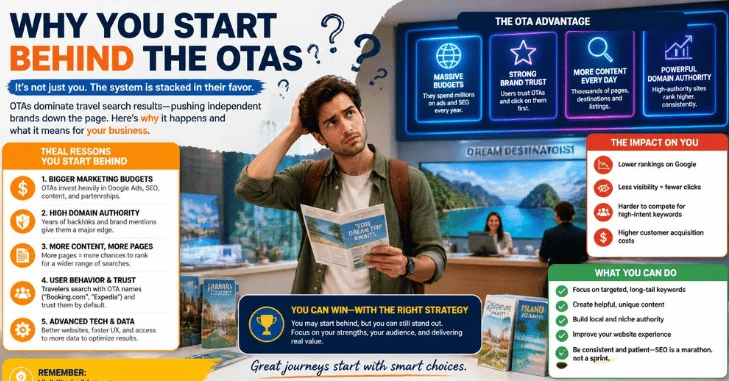
Every big OTA carries millions of pages and decades of links you cannot match. On a query like “hotels in Savannah,” you will not outrank Booking.com this year. Chasing it burns the budget. The winnable ground is narrower and more specific. Travel SEO services: small group sunrise tours, pet-friendly cabins with a hot tub, wedding blocks near a particular venue, and English-speaking guides in a city where that is rare.
These queries convert better anyway, because the traveler has already decided what they want. Local visibility is the other half. Your business profile and review handling feed the map results, and the same signals now shape the answers travelers get from AI assistants. If that groundwork is thin, start with local SEO and AI business listings before anyone touches your blog.
What the Work Actually Includes
Credible scopes cover five areas. Anything that skips the last two is a general SEO retainer wearing a travel label.
- Technical foundations. Crawl control over filtered inventory, faceted URL rules, image weight on gallery-heavy pages, and Core Web Vitals on a booking engine you may not fully control.
- Page architecture. Destination hubs, property or tour detail pages, and the internal links that connect them in the order a traveler researches.
- Content built to a calendar. Seasonal guides, itineraries, and events were produced ahead of demand rather than during it.
- Travel structured data and feeds. Schema plus the product feeds that place you in Google’s booking surfaces.
- Digital PR and measurement. Coverage from travel media, plus reporting that ties organic sessions to real reservations.
Destination Pages and Property Pages Are Different Jobs
Merge them, and you get hundreds of near-identical URLs. Google demotes the lot. Worse, nobody on your team can say which page was supposed to rank for the query that actually sells rooms.
| Destination page | Property or tour page | |
| Query type | Research: “things to do in,” “best time to visit” | Booking: brand, dates, room, or tour type |
| Keyword set | Broad, seasonal, question-led | Narrow, commercial, often branded |
| Template | Editorial, image-led, links out to inventory | Structured facts, availability, price, reviews |
| Internal links | Feeds the inventory below it | Points back up to the destination hub |
| Success metric | Assisted sessions and email capture | Direct bookings |
Destination pages earn their place by being useful before anyone books. A guide to things to do in Tanzania is the shape to copy: real recommendations and local detail. It then links down to the safari or lodge pages that take the reservation.
The Structured Data Travel sites keep missing.
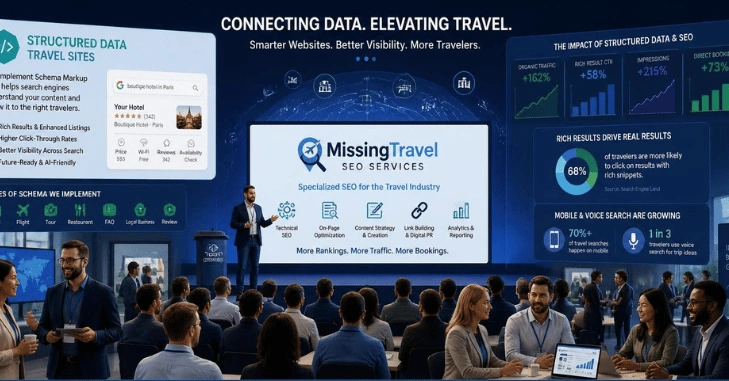
Hotels and tour operators need more markup than a standard business site, because Google builds several travel products from it. Get this wrong, and you can rank first organically while the module above you takes the click. That happens more than owners realize.
- Lodging business or hotel for properties with amenities, check-in times, and star ratings.
- TouristAttraction and TouristDestination for landmarks and area pages.
- Product with an offer for bookable tours, tickets, and packages, including price and currency.
- Event for dated departures, festivals, and seasonal openings.
- FAQ page and review markup where the content genuinely exists on the page.
Two Google programs sit alongside the markup. Free booking links put your own rates inside the hotel module at no commission. The Things to Do integration surfaces tickets and tours through a product feed sent via the Actions Center. Both need a verified business profile and current pricing data. Neither runs on schema alone.
Booking windows set the publishing calendar.
Travel demand is not evenly spread, and neither is the research that precedes it. Ski buyers browse in September and book in October. Summer coastal rentals get shortlisted in February. Publish theweek’ss demand peaks, and you have missed your own market.
The working rule is a 90-day lead time. Your seasonal page needs roughly three months to be crawled, indexed, linked, and refined before the booking window opens. That gap explains the most common argument owners have with agencies. They check rankings in the peak month, see nothing, and call the program a failure. The page was only ever built for next season.
Ask any prospective partner for a twelve-month calendar mapped to your own arrivals data. No calendar, no deal. Without one, they are planning around their own capacity rather than your demand.
Languages and currencies
Selling across borders adds two failure points. One is technical. The other costs you the sale at the last click, after you have already paid to earn the visit.
- hreflang: every language and country version needs return tags, or Google guesses and serves the wrong market.
- Translation quality: machine-translated pages rank poorly and read worse. Local phrasing for the same trip differs by market.
- Currency switching: detect and offer, never force. Changing prices by IP address without a visible switcher frustrates travelers and can hide inventory from crawlers.
- Payment and refund terms: state them in the visitor’s own currency on the page before checkout.
Conversion work matters as much as ranking here. Traffic that lands on a page quoting a currency the visitor does not use tends to leave. Show local money.
What Travel SEO services cost in 2026
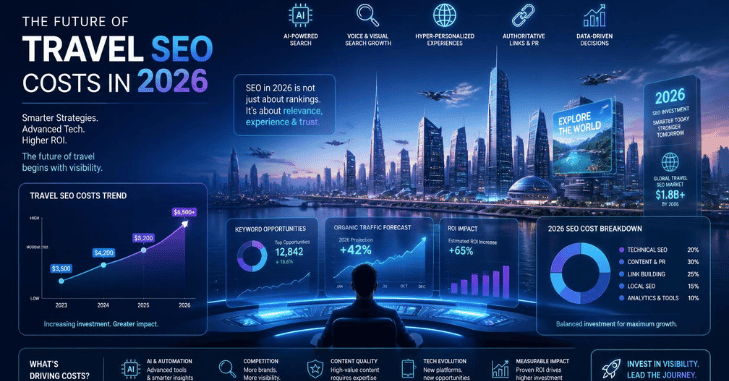
US agencies price by scope, not by industry. The range tracks how many destinations and inventory pages you carry.
| Tier | Monthly range | What the money buys |
| Single property or small operator | $750 to $2,000 | Business profile work, local citations, a few pages a month, basic reporting |
| Mid-market, several locations or tours | $3,000 to $7,500 | Technical program, schema and feeds, content calendar, digital PR, conversion testing |
| Multi-destination or multi-language brand | $10,000 and up | Dedicated team, hreflang architecture, migration support, revenue attribution |
Watch what the fee excludes. Development hours, translation, photography, and feed management are often quoted separately, and any one of them can add a third to the real bill. Get the exclusions in writing.
Agency, Freelancer, or in-House?
| Option | Best for | Pros | Cons |
| Specialist travel agency | Multi-property or multi-market brands | Knows OTA dynamics, feeds, and seasonality; ramps fast | Costs most; you may share a strategist |
| Generalist agency | Small operators with simple sites | Cheaper; broad marketing help | Learns your industry on your budget |
| Freelance consultant | One property, one language | Direct access to the expert; flexible | Limited capacity; no cover when they are away |
| In-house hire | Brands publishing weekly, all year | Owns the calendar and the CMS | Slow to hire; one person cannot cover technical, content, and PR |
My recommendation for most operators under twenty properties: hire a specialist for the first six to nine months, then keep a part-time in-house editor to run the calendar. The specialist fixes architecture and schema, which are one-time jobs. The editor keeps content shipping, which never ends. If budget is the constraint, the principles in this small business content marketing guide will carry you further than a cheap retainer.
Seven checks before you sign
Put these in the request for proposal and score the replies. Any partner worth hiring will answer all seven without hedging.
- Two travel clients you can call, ideally in your own segment.
- Which queries do they plan to concede to the OTAs, and why?
- A schema and feed audit from a past engagement, redacted if needed.
- The content calendar, mapped to your booking windows rather than to their quarters.
- How they report bookings when the brand search and the OTAs take credit for the demand your pages created.
- Who owns the analytics, the feeds, and the published pages when the contract ends.
- Their plan for month one if your booking engine blocks the fixes they recommend.
Answers to the fifth item separate serious teams from the rest. Good partners show assisted conversion paths and direct booking share. Weak ones send a rankings screenshot.
Conclusion
Travel SEO services can be a powerful investment for hotels, resorts, tour operators, vacation rental businesses, and travel agencies that want to increase organic traffic and generate more direct bookings. However, success depends on choosing a specialist who understands travel search, seasonal demand, OTA competition, technical SEO, structured data, and booking behavior.
Before signing a contract, compare the agency’s pricing, previous travel results, content strategy, technical capabilities, reporting methods, and understanding of your booking calendar. Make sure the agreement clearly explains what is included and who owns your website, analytics, feeds, and published content.
FAQ
Long-tail pages usually move within 60 to 90 days. Competitive terms such as “best food tours in Chicago” take four to six months, sometimes longer on a new domain. Seasonal pages are judged a season later, not a month later.
Yes, if you sell something specific and you can publish. Two-person kayak outfits with strong reviews can own a dozen precise queries—generic resellers with no unique inventory struggle at any budget.
On your own brand and on tightly defined experiences, yes. On broad city and hotel queries, plan to appear through the hotel module and free booking links instead.
That is the strongest case for it. Every point of direct booking share you win back is commission you keep, and organic pages keep working after the campaign stops.