

Choosing between member-managed vs manager-managed is one of the most important structural decisions when forming an LLC. The choice determines who controls daily operations, who has authority to make business decisions, and how involved owners are in running the company.
A member-managed LLC keeps management in the hands of its owners, while a manager-managed LLC delegates those responsibilities to one or more designated managers. Understanding the differences in control, authority, flexibility, and decision-making can help business owners select the structure that best fits their goals.
Short answer: which structure fits you
Pick member-managed if every owner works in the business and you want the simplest structure. Pick manager-managed if some owners are passive investors, if you plan to hire an outside operator, or if you need one person able to sign quickly. Most small LLCs stay member-managed, which is also the default in nearly every state.
Member-managed vs manager-managed at a glance.
| Member Managed Vs Manager Managed | Member-Managed LLC | Manager-Managed LLC |
| Who runs daily operations? | All owners, jointly | One or more appointed managers |
| Who can sign contracts and bind the LLC | Any member, in the ordinary course of business | Only the manager or managers |
| State default if you say nothing | Yes, in nearly every state | No, you must elect it |
| Room for passive investors | Poor, owners are presumed active | Strong, non-managing members stay hands off |
| Can an outsider run the company | No, not without admitting them as an owner | Yes, a manager need not own any part of the LLC |
| Speed of decisions | Slower, consensus-driven | Faster, authority is concentrated |
| Federal tax treatment | Unchanged by the structure | Unchanged by the structure |
| Typical fit | Two founders building a service firm | Rental property funds, family holdings, investor deals |
TL;DR
- Member-managed means every owner is an agent of the company and can bind it.
- Manager-managed narrows that authority to named managers, who may be owners or outsiders.
- Member management is the statutory default in nearly every state, so silence picks it for you.
- The Articles of Organization announce the choice publicly. The operating agreement defines what the manager may do.
- Neither structure changes your federal tax classification.
- Switching later takes an amendment and a member vote, not a new company.
Member Managed Vs Manager Managed: What a Member-Managed LLC Means in Practice

In a member-managed LLC, members share ownership and decision-making authority. When comparing member-managed vs manager-managed, the key difference is who controls daily business decisions. A member may also bind the LLC to contracts, such as an equipment lease.
This is why the structure suits small teams who already trust each other. Two founders running a design studio, three siblings holding a family building, a solo owner with no partners at all. Voting is usually by ownership percentage, though your operating agreement can set it per capita instead. Getting that document drafted properly is worth paying for, and a firm offering broad professional legal services can tailor the voting and buyout terms to your situation.
What a manager-managed LLC means for owners
A manager-managed LLC splits ownership from control. Members still own the company and still receive their share of profits. Day-to-day authority, though, belongs to one or more managers named in the operating agreement.
Often the manager is a member. The managing partner of a two-person firm is the everyday example. Managers do not have to own anything, though. Your manager could be a hired operator or an outside property management company brought in to handle tenants, repairs, and rent collection. Non-managing members keep their economic rights and their vote on major items like admitting a new owner or selling the business.
The default rule if your paperwork says nothing
Nearly every state treats an LLC as member-managed unless the formation documents say otherwise. The Revised Uniform Limited Liability Company Act, adopted in some form by roughly twenty states, follows the same approach. Manager management is an opt-in, never an accident.
That default creates a real risk for silent founders. Say one owner assumed a partner would run things and never wrote it down. Every owner now holds equal signing power. Fixing that after a dispute costs far more than checking the right box on day one.
Who can bind the LLC, and why it matters most
Apparent authority is the concept doing the heavy lifting here. Suppose an outsider reasonably believes someone can act for your LLC. That outsider is often protected. Your private rules will not always save you. In a member-managed company, any member can create that impression by signing in the ordinary course of business.
Naming managers narrows the pool of people who can do that. Banks and title companies also read the state record, so a public filing that names managers gives them someone specific to deal with. States following the newer Uniform Act dropped the automatic statutory authority rule and instead let an LLC file a statement of authority. That optional filing spells out exactly who may transfer property or sign on the company’s behalf.
Articles of Organization versus the operating agreement
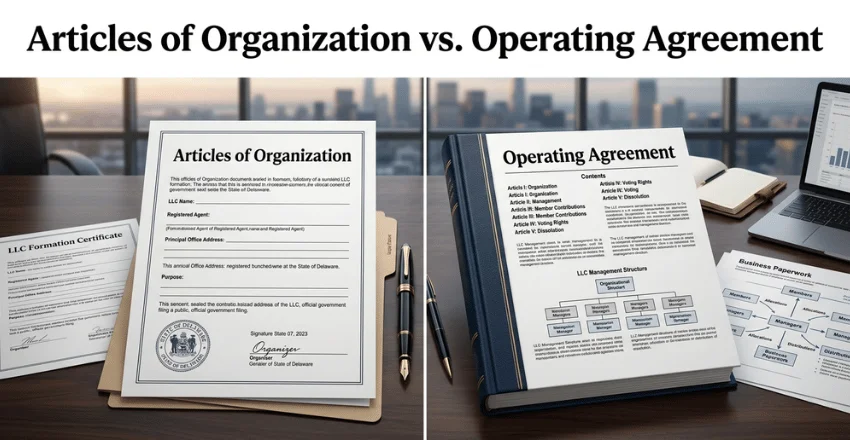
These two documents do different jobs. Confusing them causes most of the trouble, because founders assume the public filing settles questions that only the private agreement can answer.
The Articles of Organization, filed with your Secretary of State, are public. Most states ask you to check whether the company is member-managed or manager-managed, and some ask for manager names. Filing fees for a standard LLC run roughly $50 to $500 depending on the state.
The operating agreement is private and does the detailed work. It names the managers, sets their term, caps what they may approve alone, and lists the decisions still reserved to a member vote. Good agreements reserve a few things. Member approval should be required for borrowing above a set dollar figure, selling major assets, or admitting a new owner. Also worth reading: A Funny Way of Saying Sorry.
Pros and cons of each setup
Member-managed advantages: simple to explain, no extra titles to track, every owner stays informed, and it matches the default so your filing is straightforward.
Drawbacks of member management: decisions slow down as owners multiply, any member can bind the company, and outside investors dislike being handed operational duties they never wanted.
Manager-managed advantages: clean authority, credible to lenders, room for passive capital, and the ability to bring in professional talent without giving away ownership.
Manager-managed drawbacks: more drafting work, more governance to maintain, and real dependence on the person you appointed. Weak oversight of a powerful manager is a genuine risk.
Does the choice change your taxes? No
This is the most common misconception on the topic. Management structure has nothing to do with how the IRS sorts your company. According to the IRS, a domestic LLC with at least two members is classified as a partnership for federal income tax purposes unless it files Form 8832. That election carries its own 75-day timing window. A one-owner LLC is a disregarded entity by default. Member count drives the test, not who signs the checks.
Self-employment tax analysis can shift when a member stops working in the business. So the bookkeeping does change a little. Talk it through with your accountant first. Their cash flow planning tips help you model what payouts to non-managing owners look like over a full year.
The verdict: who should pick which
Choose member-managed if you are a one-owner LLC, all owners work in the business, and nobody holds a stake purely for return. Fewer than about five owners keeps it workable. This covers most consulting firms, trade businesses, agencies, and small shops.
Choose manager-managed if you have investors who want no operational role, or if several families are pooling money. The same applies when you want a hired operator, or expect ten or more owners. Rental and development entities are the classic case. Capital partners in a property investment deal want returns rather than tenant calls.
One more scenario deserves its own line. If a member wants to be treated as a passive investor for legal purposes, manager-managed is the structure that supports the claim. Their limited role has to be real, documented, and consistent with how they behave.
Hiring an outside manager is a hiring decision, not a formality. Build a fair, structured recruiting process before handing anyone the authority to sign for your company.
How to switch structures later

Nothing about this decision is permanent. The process usually takes a few weeks.
- Check your operating agreement for the amendment threshold, often a majority or two-thirds of ownership.
- Hold the vote and record written consent signed by the members.
- Amend the operating agreement to name the managers and define their authority.
- File an amendment to the Articles of Organization with your Secretary of State, typically for a fee under $100.
- Update your bank signature cards, insurance policies, and vendor accounts.
- Tell anyone who relied on the old arrangement, so nobody keeps signing without authority.
Your next step
Decide this before you file. Do not wait for a disagreement to force it. Write down who runs the company, what that person can approve alone, and what still needs a vote. Then match your Articles of Organization to that answer and have an attorney review the operating agreement. An hour of drafting now is cheaper than any argument about member-managed vs. manager-managed authority later.
Frequently asked questions
Every owner holds authority in one, and only appointed managers hold it in the other. Ownership percentages stay the same either way.
Yes. A managing member is both, and this is the most common arrangement in small companies that elect manager management.
Not automatically. Managers hold authority, not equity, unless they are separately admitted as members.
No. They usually keep votes on structural matters, including amendments, new members, dissolution, and the sale of the company.
Manager management costs a little more, mostly in drafting time. State filing fees are generally identical.
In nearly every state, yes. Confirm on your own Secretary of State’s LLC page, since a handful of states word the form differently.