
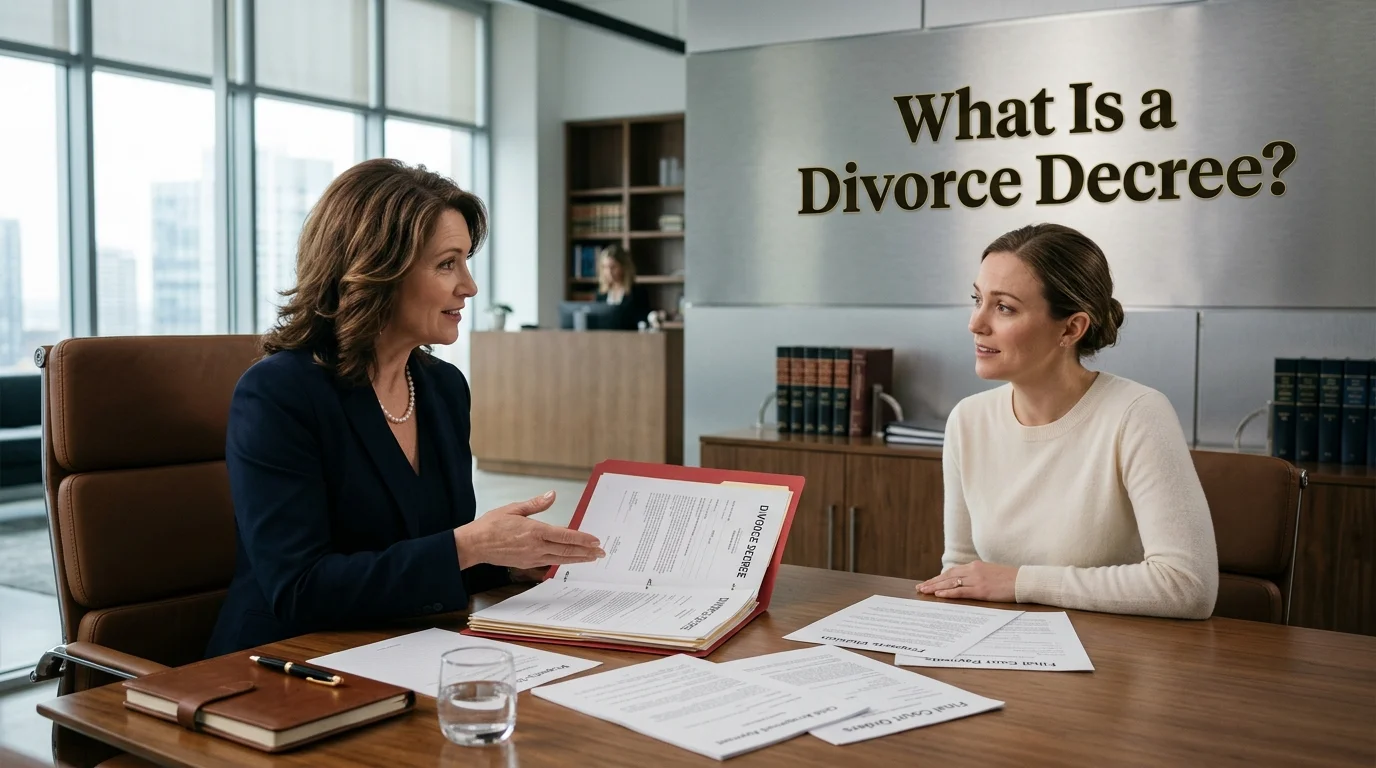
Your divorce is final, and the court hands you a stack of paper. Then a bank, a passport office, or the Social Security Administration asks for “the decree,” and you have no idea which page they mean. So what is a divorce decree, and why does everyone keep asking for it?
Quick answer: A divorce decree is the final written order a state family court judge signs to end a marriage. It names both spouses, states the date the marriage ended, and spells out the binding terms: property division, debt, spousal support, child custody, parenting time, and child support. It is enforceable in court.
Decree, Certificate or Judgment? The Three Documents People Mix Up
These three names get used as if they mean the same thing. They do not, and ordering the wrong one wastes weeks. Here is the difference in one place.
| Document | Who issues it | What it contains | Typical use |
|---|---|---|---|
| Divorce decree | The state family court, signed by the judge, filed with the county clerk | Every term of the divorce, often 10 to 40 pages | Proving custody, dividing retirement accounts, refinancing, enforcement |
| Divorce certificate | The state vital records or health department | Both names, the county, and the date the marriage ended. Usually one page | Name changes, remarriage license, quick proof of status |
| Final judgment of divorce | The same court | The judge’s ruling itself. In many states the judgment and the decree are one signed document | Same as the decree; the label just varies by state |
The short version: the court writes the decree, the state records the certificate. Judgment is mostly a naming difference. Texas courts say “final decree of divorce,” Florida and New York courts say “final judgment of dissolution of marriage,” and both do the same job. If a form asks for a judgment and you hold a decree, you almost certainly have the right paper.
TL;DR
- The decree is the judge’s signed final order. It controls property, debt, support, and custody.
- The certificate is a one-page vital record. It proves you are divorced but not on what terms.
- You get the decree from the county clerk where the case was filed, and the certificate from state vital records.
- Certified copies run roughly $10 to $45 depending on the state and how you order.
- Terms about children and support can be modified. Property division almost never can.
- Keep two certified copies. You will be asked for one more often than you expect.
What Is a Divorce Decree Made Of? A Section-by-Section Look

Most decrees follow the same skeleton, because state courts work from standard templates. Knowing the order saves you from rereading 30 pages every time a lender asks a question.
- Caption and case number. Court name, county, both parties, and the docket number. Every later filing references this number.
- Findings. Residency, the grounds, and confirmation that the court has authority over the case and the children.
- Dissolution. One or two lines that actually end the marriage, with the effective date.
- Property and debt. Who keeps the house, the cars, the accounts, and the retirement plans. Also who pays which loan.
- Spousal support. Amount, frequency, start date, end date, and what triggers a stop.
- Custody and parenting time. Legal custody, physical custody, the holiday schedule, and how exchanges happen.
- Child support. The monthly figure, health insurance, uncovered medical costs, and tax claim rules.
- Name restoration. A line restoring a former name, if either spouse asked for it.
- Signatures. The judge’s signature and the file stamp date. Without both, the order is not final.
Two sections cause most of the confusion later. Retirement accounts often need a separate order, called a QDRO, before a plan administrator will move money. A real estate clause also tends to give one spouse a deadline to refinance. That one is easy to miss while you are still working through the steps of the divorce process itself.
How to Get a Certified Copy, and What It Costs
A plain photocopy will not satisfy a bank or a federal agency. They want a certified copy, which carries the clerk’s raised seal or stamp confirming it matches the court’s file.
Go to the clerk of court in the county where the case was heard. Not the state, not the courthouse nearest you today. Bring the case number if you have it, plus your full name at the time of the divorce, your former spouse’s name, and the approximate year. Photo ID is standard. Many counties now let you order online, and mailed requests usually take one to three weeks.
Prices vary by county and are often charged per page plus a certification fee, so a long decree costs more than a short one. Expect somewhere around $10 to $30 in most counties. Certificates follow their own schedule. According to the New York State Department of Health, a mailed certificate copy costs $30, while an online or phone order costs $45 plus a vendor processing fee. That gap between mail and online pricing is common nationwide, so order by mail if you are not in a hurry.
One practical note from people who have done this twice: ask for two certified copies while you are already at the counter. The second copy is usually cheaper than the first, and agencies sometimes keep the one you hand over.
The Errands That Actually Require a Certified Copy
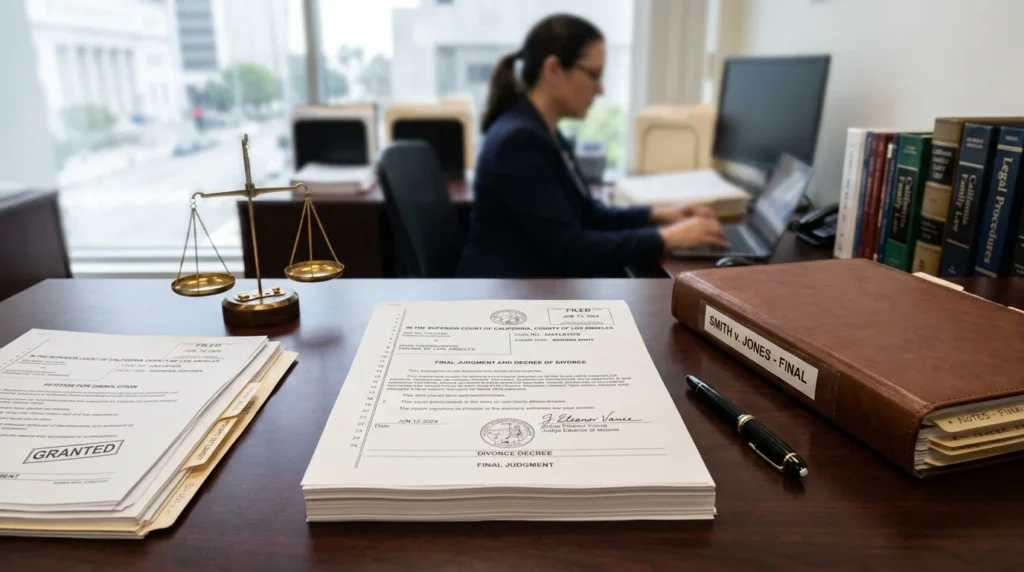
This is the part that thin definition pages skip. Here is where the paper gets demanded.
- Social Security name change. The SSA accepts a certified decree that shows the name restoration. A certificate alone often fails, because it does not order the change.
- Driver’s license and passport. State DMVs and the State Department both want certified proof linking your old name to your new one.
- Remarriage. County license clerks want proof the prior marriage ended. A certificate normally clears this one.
- Mortgage and refinancing. Underwriters read the support sections to decide whether alimony counts as income or as debt.
- Retirement and pension transfers. Plan administrators want the decree plus the QDRO before splitting a 401(k).
- Health insurance and taxes. Insurers need the end date, and the IRS cares who claims the children.
The decree also resets your estate planning, and that part has no deadline reminding you. Beneficiary designations on life insurance and retirement accounts do not update themselves, and in many states a will written during the marriage still names your former spouse. Reviewing how a will and a living trust work together is a sensible next step once the file stamp dries.
Lost It? Here Is How to Track Down an Old Decree
Court records do not expire. Even a divorce from 1978 sits in a file somewhere, so a missing copy is an errand rather than a crisis. Start with the county clerk where you filed. If you cannot remember the county, most state court systems run a free online case search by name. When the county has since digitised or transferred its old files, the clerk will point you to the state archives. Divorces granted before your state started central recordkeeping may only exist on paper or microfilm, which adds a few weeks.
Two harder cases come up often. If you moved states, you still order from the original county, not your new one. If the divorce happened overseas during military service, request records through the court that granted it. The base legal assistance office can help you locate it. Your former attorney’s file is also worth a call, since firms often keep closed matters for a decade or more.
Changing the Order Versus Making It Stick

People use “modify” and “enforce” as if they were one action. They are opposite moves, and mixing them up in a filing gets it kicked back.
Modification changes a term in the future. You file a motion to modify in the same court and show a substantial change in circumstances: a job loss, a relocation, a serious illness, or a child’s changed needs. Child support, custody, and parenting time are all modifiable. Spousal support depends on what the order says, since some awards are locked. Property division is generally final once the appeal window closes, which is why signing a bad settlement is so costly.
Enforcement means the terms stay put and your ex has to follow them. You file a motion for contempt, and courts have real tools: wage garnishment, licence suspension, interception of tax refunds, liens, attorney fee awards, and, in stubborn cases, jail time. Keep records of every missed payment with dates.
Joint debt is the trap here. A decree binds your former spouse to the court, but it does not bind the credit card company, which never signed anything. If your name stays on the account, a missed payment still lands on your report. Understanding the types of credit that affect your score helps you decide which accounts to close, refinance, or watch.
Your Next Step
Do one thing this week: call the county clerk where your case was filed and order two certified copies. Store one in a fireproof box and scan the other. Then read your property and support sections start to finish, and flag any deadline that has already passed. Is a term being ignored, or does it no longer fit your life? Talk to a family law attorney in your state about a motion to modify or enforce.
Frequently Asked Questions
It is the judge’s final written order ending your marriage and setting the rules you both have to follow afterward. Think of it as the rulebook for everything that happens after the case closes.
Usually two to six weeks. The judge signs, the clerk files it, and copies go out by mail or through the court’s electronic system. Contested cases with complicated property take longer.
Yes. You are divorced on the date the judge signs, and the clerk enters the order, not on the day the papers reach your mailbox. Some states add a short waiting period before you can remarry.
Many county clerks offer online ordering, and some state judiciaries post case dockets publicly. Private sites that resell records charge more and often send uncertified printouts, so start with the county.
Support, custody, and parenting time can be modified if circumstances change substantially. Property and debt division is nearly always permanent, so read those clauses closely before you agree to anything.
File a motion for contempt in the court that issued the order. Bring your written record of what was missed. Judges take violations of their own orders seriously.