
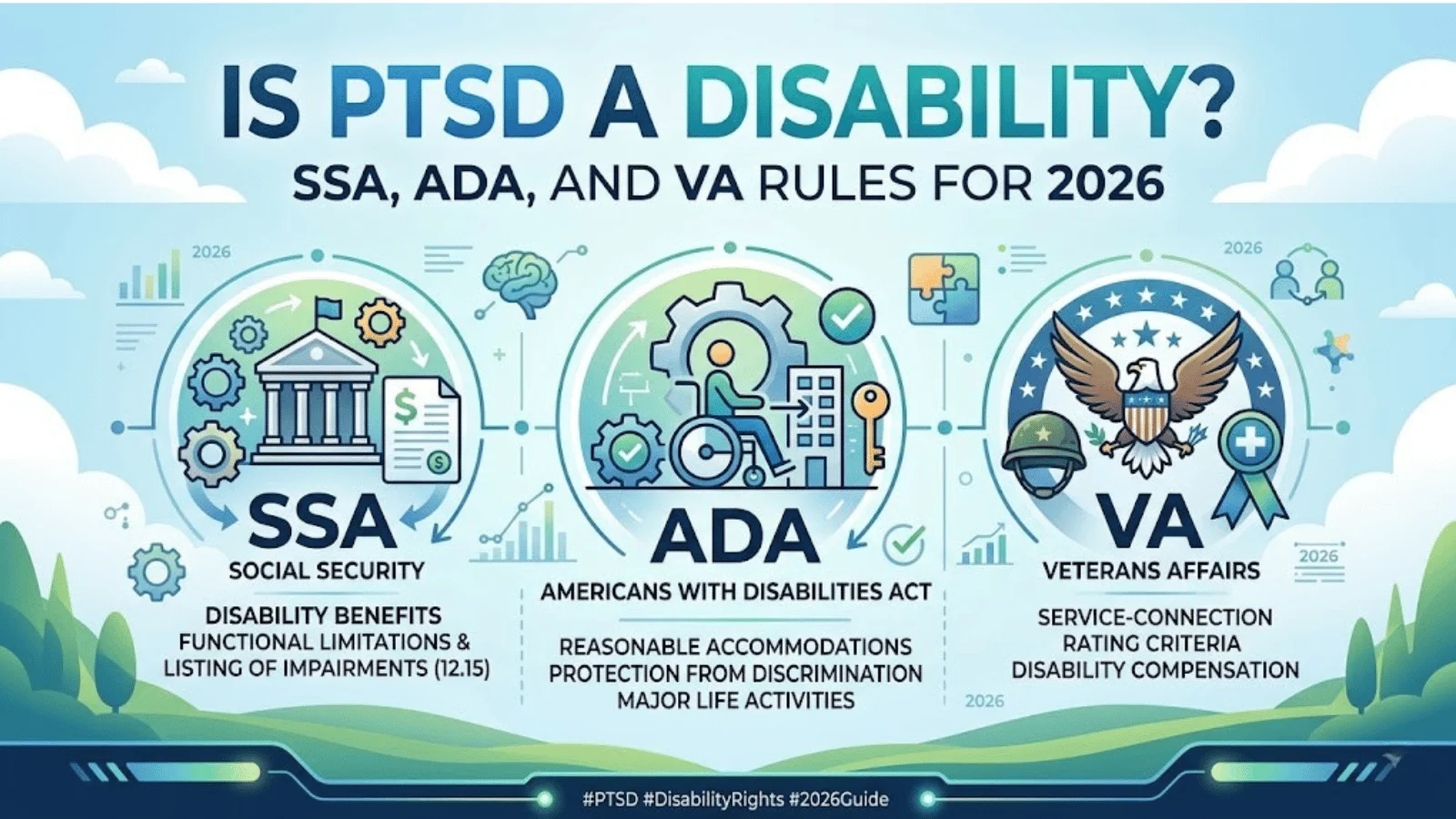
You probably want an answer you can act on, not a textbook definition. Three separate American systems answer this question, and each one uses its own test. Sorting out which one applies to you is most of the work.
Short answer: Yes. Is PTSD a disability that is legally considered one in the United States? It can be, under all three frameworks, though each applies its own test. Social Security pays benefits when the condition stops you from working. The Americans with Disabilities Act protects your job instead. The VA assigns a percentage for service-connected trauma.
The three systems at a glance
These programs share a word and almost nothing else. A decision in one does not settle the others, which is where most confusion starts.
| System | What counts as a disability | What you receive | Who decides |
|---|---|---|---|
| Social Security (SSDI and SSI) | A severe impairment expected to last 12 months or longer that prevents substantial work | A monthly cash benefit, plus Medicare or Medicaid depending on the program | Your state Disability Determination Services office, on behalf of the SSA |
| ADA and the EEOC | A condition that substantially limits a major life activity, including thinking, sleeping, and concentrating | Reasonable accommodations at work and protection from discrimination | Your employer first, then the EEOC or a court |
| VA disability compensation | A service-connected condition, rated 0 to 100 percent by how much it impairs occupational and social functioning | A tax-free monthly payment scaled to the rating, plus VA health care access | The Department of Veterans Affairs |
Key takeaways
- Three systems, three tests. Qualifying under one says nothing about the others.
- Social Security looks at function, not at your diagnosis label.
- The ADA covers you while you are still working, which surprises many readers.
- VA ratings come in fixed steps: 0, 10, 30, 50, 70, and 100 percent.
- Denials are common and appealable, so a first no is rarely the last word.
Is PTSD a Disability Under Social Security Rules?

Social Security evaluates trauma and stressor-related conditions under listing 12.15 of its Blue Book. That listing has three paragraphs. Paragraph A asks for medical documentation of the classic symptom set: exposure to a traumatic event, intrusive memories, avoidance, mood or behavior changes, and heightened alertness.
Paragraph B is where most claims are won or lost. According to the Social Security Administration’s adult mental disorders guidance, you must show extreme limitation in one area of mental functioning, or marked limitation in two. Those four areas are understanding and applying information, interacting with others, concentrating and keeping pace, and adapting or managing yourself. Paragraph C is a second route, open to people with at least 24 months of documented history whose symptoms stay controlled only through ongoing treatment and a highly structured setting.
Notice what the agency never asks. It does not assign a percentage, and it does not care how severe the diagnosis sounds on paper. It asks what you can still do for eight hours a day, five days a week.
SSDI requires enough recent work credits. SSI is needs-based and looks at income and assets instead. Both use the same medical standard, so the difference is financial rather than clinical.
Diagnosis itself belongs to a clinician, not to a website. If nobody has evaluated you yet, that is the first step, because untreated records are the single most common reason claims fail. Working with specialist mental health services creates the treatment history these decisions rest on.
Your rights at work under the ADA
Here is the part most articles skip. The ADA does not require you to stop working. It applies precisely because you are working, or trying to.
Amendments passed in 2008 widened the law’s reach on purpose. A condition that flares and settles still counts, judged by how limiting it is when active. Employers with 15 or more staff must consider reasonable accommodations unless the change causes undue hardship.
Accommodations are usually smaller than people expect:
- A flexible schedule for therapy appointments
- A quieter workspace, or one away from a busy entrance
- Noise-canceling headphones or permission for short breaks after a trigger
- Written instructions instead of spoken ones
- Remote work on days when commuting is the hardest part
- A support animal, where the role allows it
You do not have to hand over your full medical file. You ask for a change at work and link it to a health condition. Your employer may request limited documentation confirming the need. If the request is refused or you face retaliation, the EEOC takes charges, and it helps to know your employment rights before that conversation happens.
How the VA rates trauma for veterans
Veterans use a third system, and it is the only one that speaks in percentages. Ratings under diagnostic code 9411 land at 0, 10, 30, 50, 70 or 100 percent. That scale measures how far symptoms reduce occupational and social functioning, from mild interference at 10 percent to total impairment at 100.
Money follows the number. According to the Department of Veterans Affairs, the compensation rates published for December 1, 2025 pay a veteran with no dependents $1,808.45 a month at 70 percent. At 50 percent, the same veteran receives $1,132.90 instead. Dependents raise both figures.
Three elements build a claim: a current diagnosis, an in-service stressor, and a medical link between them. Combat, fear of hostile activity, and military sexual trauma each have their own evidence rules, and the stressor standard is easier to meet than many veterans assume.
One warning worth repeating. A 70 percent VA rating does not entitle you to Social Security benefits. Both agencies use unrelated standards, and Social Security expedites certain veterans’ claims without adopting the rating itself.
The evidence that decides these claims
Every one of these systems runs on documentation. Strong claims tend to share the same features:
- Consistent treatment records. Regular visits over months carry far more weight than one evaluation.
- Functional detail, not labels. “Left three shifts early after panic episodes” beats “symptoms are severe.”
- Statements from people who see you daily. A spouse, a supervisor, or a friend can describe what records miss.
- An honest account of bad days. Describing your worst week rather than your best one is not an exaggeration; it is accuracy.
Gaps in care get read as improvement, fairly or not. If cost or access has kept you away from appointments, say so in writing rather than leaving the silence to be interpreted.
What to do if your claim is denied

A denial is routine, not a verdict on whether you are struggling. Most mental health claims are turned down at the first stage, and many succeed later.
Social Security offers four levels: reconsideration, a hearing before an administrative law judge, the Appeals Council, then federal court. Deadlines are short, usually 60 days, and missing one restarts everything. Veterans choose among a supplemental claim with new evidence, a higher-level review, or an appeal to the Board of Veterans’ Appeals.
Most people do better with representation at the hearing stage. Patience and paperwork win these cases, and reading how compensation appeals actually work takes some of the mystery out of a first denial.
Staying steady while you wait

Claims take months, and that waiting period is its own burden. Keep a short symptom journal, since it doubles as evidence and as something to show your clinician. Small, repeatable daily habits that protect your health also matter more than they sound, because sleep, movement and routine are the things trauma disrupts first.
Where to go from here
Is PTSD a disability in your situation? Answer it one system at a time. Still working and struggling? Start with an accommodation request at your job. Readers who cannot sustain full-time work should open a Social Security application and get treatment onto the record. Veterans with service-connected trauma file with the VA and pursue the rating they have earned. Book an evaluation with a licensed clinician this month, because every route above begins with that record.
Frequently asked questions
No. No condition is approved on its name alone. Social Security, the ADA and the VA each require evidence about how the condition affects your functioning, which is why two people with the same diagnosis get different outcomes.
Under the ADA, yes, that is the entire point. For Social Security, earnings above the substantial gainful activity limit usually block approval, though part-time work below that line does not. The VA pays compensation whether or not you work, except in specific unemployability cases.
Initial Social Security decisions commonly run six to eight months, and a hearing can add a year or more. VA claims often decide faster. Accommodation requests should be handled in weeks, not months.
It helps as evidence, since the medical records behind it are useful. It does not bind the decision. You still have to meet the listing or show you cannot sustain full-time work.
Requesting an accommodation is protected activity, and firing someone for it is unlawful retaliation. Document your requests in writing and keep copies at home.