

Two advertisers chase the same click. One bids $12 behind a vague ad and a slow homepage; the other bids $7 with a tight ad and a landing page that matches it. The $7 advertiser often takes the higher slot and pays less for the click. That gap between spend and position is the part of paid search marketing most guides skip.
How the auction decides which ad shows first

Search ads run on an auction that reruns for every query. Google scores each eligible ad with Ad Rank. Six things feed that score: your bid, the quality of your ad and landing page, minimum thresholds, how close the competition is, the searcher’s context, and your ad assets. The highest Ad Rank wins the top slot. The highest bid does not.
Put rough numbers on it. Google’s diagnostic Quality Score runs from 1 to 10, so borrow it as a stand-in for quality. A $12 bid at quality 4 scores 48. A $7 bid at quality 8 scores 56. So the cheaper advertiser wins the slot on a bid 42 percent lower.
Google’s own help documentation works an example with four Ad Rank scores: 80, 50, 30 and 10. Say the minimum to appear anywhere is 0, and the minimum for the block above the results is 40. Only the 80 and the 50 sit at the top of the page. The 30 and the 10 still show, lower down.
So you face two hurdles, not one. Clear a threshold to be eligible. Then compete on rank against everyone else who cleared it.
The campaign types you can actually buy
Google Ads and Microsoft Advertising both sell more than text ads on a results page. Each type buys a different kind of attention, and judging them all by click-through rate is the fastest way to kill a campaign that was working.
| Campaign type | What it is for | Buying intent | Metric that says it is working |
|---|---|---|---|
| Search | Text ads matched to keywords on the results page | Highest. The person typed the need in their own words | Cost per conversion on non-brand search terms |
| Shopping | Product listings with image, price and store name, pulled from a Merchant Center feed | High and specific. They named a product or category | Return on ad spend per product, not the account average |
| Performance Max | One campaign across Search, Shopping, YouTube, Discover, Gmail, Maps, and Display | Mixed. It blends demand you captured with demand it found | Extra conversions beyond what Search and Shopping already delivered |
| Demand Gen | Video and image ads on YouTube, Shorts, Discover, Gmail and the Display Network | Low. Nobody searched for you | New-customer conversions plus brand, search or conversion lift tests |
| Display remarketing | Image ads following people who already visited your site | Warm but passive. Interest without a live query | Return visits and assisted conversions, never last-click alone |
One date is worth marking. Google Display Ads campaigns are moving into Demand Gen, with an in-account migration tool opening to eligible advertisers in June 2026. If your remarketing sits in a standalone Display campaign, plan for that move rather than discovering it.
Local businesses face an extra wrinkle, because store visits compete with map results and AI-generated answers on the same screen. Reading up on how local listings and voice search behave is worth an hour before you set a geographic radius.
Key takeaways
- Ad Rank, not your bid, sets your position. Quality is a real lever on cost.
- The 1 to 10 Quality Score is a diagnostic tool, not the number used in the live auction.
- Each campaign type buys a different intent, so each needs its own success metric.
- Performance Max trades keyword-level control for reach across every Google surface.
- Judge the channel on cost per conversion, not on clicks or impression share.
What Quality Score really does to your cost per click
Quality Score is reported on a 1 to 10 scale. It rolls up three things: expected click-through rate, ad relevance, and landing page experience. Most guides then print the formula “bid times Quality Score” and move on.
Google says something different. That 1 to 10 number is an aggregated estimate of past performance, and Google’s help center states plainly that it is not used at auction time to determine Ad Rank. Instead, the auction takes a live quality reading for that specific search, on that device, at that moment. Your reporting column holds a diagnostic, and Google tells advertisers to treat it as one.
Cost still moves with quality, and it moves in a precise place.
You set a maximum bid, and you normally pay less than that maximum. Google notes that low-quality ads push your actual cost per click close to your maximum, even when few competitors bid on the term. Read it backwards, and you have the honest version. Quality hands you no coupon. It widens the gap between what you were willing to pay and what you get charged, and that gap is your margin.
Where paid search marketing fits against SEO and paid social
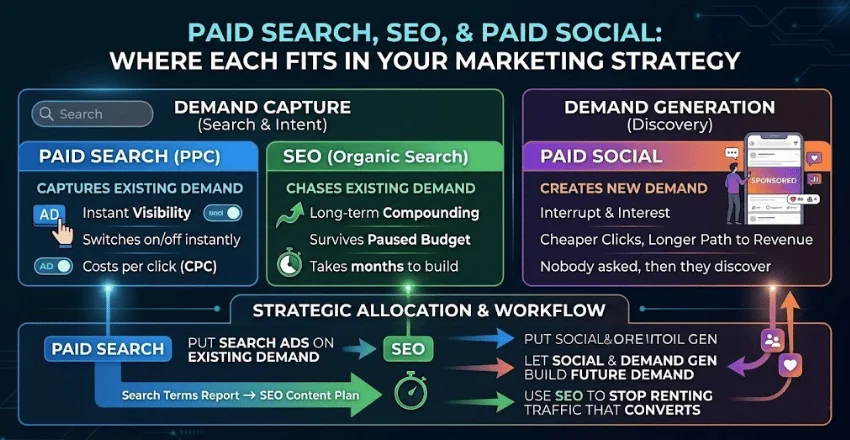
The channel captures demand. It does not create it. Someone already decided they wanted an emergency plumber or a standing desk, and your ad meets them at the moment they type it.
Search engine optimization chases the same moment without the per-click charge. It compounds, it survives a paused budget, and it takes months. Ads switch on this afternoon and switch off the day the card declines. Most healthy accounts run both, and use the search terms report from the ads to decide what the organic side should publish next.
Paid social works the other way around. Nobody on a feed asked for your product, so the ad has to interrupt, interest, and only then sell. That earlier position usually means cheaper clicks and a longer path to revenue. If you are weighing budget between ads and owned assets, a realistic content plan for a small business tends to change the split more than any bidding tweak.
A simple way to allocate. Put search ads on demand that already exists. Let social and Demand Gen build demand you can capture later. Use SEO so you stop renting traffic that has proven it converts.
How much control Performance Max actually gives up
Performance Max is one campaign reaching every Google surface, steered by Smart Bidding toward a conversion goal. That is genuinely useful, and it is also a trade.
You lose keyword-level bidding. Hard audience targeting goes too, because audience signals steer the system toward likely buyers rather than restricting it to them. Separate budgets by channel aren’t on offer either, so the split between YouTube and Search isn’t yours to set.
Controls you keep are narrower than they sound. Google lists search themes, negative keywords, brand exclusions, final URL expansion, and account-level brand safety settings. Search themes carry roughly the weight of phrase and broad match. No search theme can pin a campaign to one query the way an exact-match keyword does.
Reporting has improved and still stops short. Asset-level metrics, asset group reporting, channel performance and placement reports are all there, but no keyword-by-keyword view is.
One rule keeps the two campaign types from fighting. If a query matches an exact-match keyword in your Search campaign, Google prioritizes that Search campaign. Brand terms can still leak across, so set brand exclusions or negatives on day one.
The honest read: this works best next to Search and Shopping campaigns that already convert, in an account with clean conversion tracking. As a first and only campaign, it hides the thing a beginner most needs to see: which query earned the sale.
How to tell whether the channel is working

Clicks are not the product. Revenue is. These five checks survive contact with a real account.
- Split brand from non-brand. People searching your company name were going to find you anyway. Blended numbers that include them will always look excellent.
- Read the search terms report weekly. Broad match and search themes both bring in queries you never chose. Add negatives before the waste compounds.
- Track cost per conversion against a number you set first. Decide what a lead or a sale is worth, then judge the account against that figure rather than against last month.
- Check conversion quality, not just count. Form fills that never answer the phone are a tracking success and a business failure.
- Give changes time. Automated bidding needs a learning period, and edits made every other day guarantee you learn nothing.
Vertical context matters too. A dental practice and a parts wholesaler need different lead volumes to justify the same monthly spend. Seeing how practices build search visibility shows how narrow a profitable keyword set can be.
Where to start
Pick one campaign type that matches the intent you want. Write one honest ad, and point it at a page that delivers what the ad promised. Then watch cost per conversion for a full month before touching anything. Done that way, paid search marketing stops being a bidding war and becomes a pricing exercise you control.
Frequently asked questions
Yes, if you narrow the target. A small budget spread across 200 keywords buys noise. That same money on five high-intent terms, one tightly matched landing page, and working conversion tracking can produce a readable result in weeks.
Every auction sets its own price, so the answer moves by industry, location, device, and hour. Legal and insurance terms cost many times what a hobby retailer pays. Watch cost per conversion instead, because a $2 click that never converts is dearer than a $20 click that does.
Performance Max is a campaign type spanning multiple surfaces. AI Max is an opt-in set of AI features inside Search campaigns, covering expanded query matching, asset personalization, and URL routing. Microsoft draws the same distinction in its own documentation.
Broadly, yes. Microsoft runs Search, Shopping, Performance Max, Audience ads on its native network, and Dynamic Search Ads. It also imports eligible campaigns from Google Ads, though imported budgets, feeds, and settings deserve a review before they run.
Traffic arrives within hours. A trustworthy read on performance takes two to four weeks of steady spend, and enough conversions for the bidding to settle. Judging an account after three days is how good campaigns get switched off.