

A question about your identity can feel much harder than a question about your job, hometown, or hobbies. If you’re searching “how do you answer who am i,” the goal isn’t to find one perfect label. A useful answer combines your values, strengths, roles, experiences, and the person you are becoming.
Direct answer: Answer by combining four things: the roles you hold, the values that guide your choices, the strengths you consistently show, and the direction you want to grow. Keep the answer relevant to the setting. Use one or two concrete examples so your description sounds personal, not like a list of labels.
| Part of your answer | What to think about | Simple example |
|---|---|---|
| Roles | Responsibilities and relationships | Student, parent, designer, teammate |
| Values | Principles that guide choices | Honesty, curiosity, independence |
| Strengths | Qualities you show consistently | Patient, organized, creative |
| Experiences | Events that shaped your outlook | Moving, changing careers, volunteering |
| Interests | Activities that hold your attention | Music, sports, technology, reading |
| Direction | The person you want to become | More confident, skilled, helpful |
What Is the Question Really Asking?
The identity question usually asks for more than your name or occupation. The American Psychological Association defines self-concept as your description and evaluation of yourself, including qualities, abilities, physical characteristics, and roles. Identity also includes values, goals, beliefs, relationships, and a sense of continuity across time.
That means your answer can contain both stable qualities and changing parts of your life. You might be a college student today and a manager ten years from now, while curiosity or loyalty remains important to you. A strong description recognizes both parts instead of treating one title as your entire identity.
How Do You Answer Who Am I? Use This 7-Step Method.
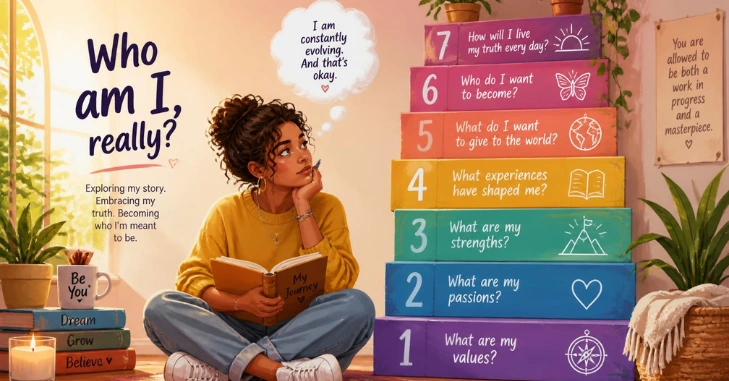
You don’t need a dramatic life story to describe yourself clearly. Start with concrete facts, then move toward the qualities and principles beneath them. This structure works for private reflection and can be shortened for interviews, classes, applications, or conversations.
What You’ll Need
Find a quiet place and take a few minutes without trying to impress anyone. A notebook or notes app helps because writing your answers makes patterns easier to notice. Treat the exercise as a snapshot of who you are now rather than a permanent definition.
- Write down the roles you currently hold. Start with straightforward descriptions such as student, parent, employee, friend, volunteer, artist, or business owner. Then notice which roles matter most to your sense of responsibility and belonging.
- Identify three to five personal values. Think about principles that affect real decisions, such as honesty, family, independence, fairness, creativity, learning, or service. A value becomes more meaningful when you can remember a choice that reflects it.
- Name your strongest recurring qualities. Focus on traits that appear in your behavior rather than flattering adjectives you wish were true. Ask what friends, coworkers, or family members would probably recognize in you.
- Look at experiences that shaped you. Consider challenges, achievements, relationships, moves, losses, education, or work experiences that changed your perspective. Choose experiences that explain something about your present character.
- Notice what holds your attention. Interests often reveal parts of identity that job titles miss. What you read, build, practice, discuss, or spend free time learning can show curiosity and motivation.
- Describe what you are working toward. Identity is partly about the present and partly about direction. Name a skill, habit, responsibility, or character quality you want to develop next.
- Combine the strongest points into a short answer. Choose details that fit the situation instead of trying to include everything. Read the answer aloud and remove anything that sounds borrowed, exaggerated, or disconnected from your behavior.
A similar open-ended approach appears in the Twenty Statements Test, a long-used self-concept exercise that asks people to complete versions of “I am…” repeatedly. Research using the method has grouped responses around traits, values, interests, goals, and social attributes. The exercise is useful because it produces many possible descriptions before you decide which ones matter most.
A Simple Formula for Building Your Answer
A practical formula is role + quality + value + evidence + direction. You do not have to use every element every time, because the setting determines how much detail belongs in the response. The formula gives you enough structure to avoid both vague statements and an exhausting autobiography.
For example, someone might say they are a marketing student who enjoys solving communication problems and values curiosity and reliability. They could add that organizing a campus project helped them discover that they work well when coordinating different people. They might finish by saying they are now developing stronger analytical skills for a future career.
| Situation | Best focus | Suggested length |
|---|---|---|
| Job interview | Strengths, experience, professional direction | 30–60 seconds |
| Classroom introduction | Background, interests, goals | 3–5 sentences |
| Reflective essay | Values, experiences, growth | Several paragraphs |
| Personal journal | Honest patterns, doubts, aspirations | No fixed limit |
| New social setting | Interests, personality, common ground | 2–4 sentences |
Example Answers for Different Situations
Example for a Job Interview
“I’m a detail-oriented person who enjoys solving practical problems and working with people. Reliability matters to me, so I tend to prepare carefully and follow through on commitments. My recent experience has helped me become more confident communicating with different personalities, and I’m looking for work where I can keep building those skills.”
An interview answer should connect identity with evidence that matters to the employer. Avoid sharing your full personal history when the interviewer needs to understand how you work and what motivates you. Magazism’s article on recruiting and candidate evaluation offers related workplace context for understanding how employers assess candidates.
Example for School or College
“I’m a student who enjoys understanding why people and systems work the way they do. Curiosity and independence matter to me, which is why I like projects that require research rather than memorization. I’m still deciding exactly where I want my studies to lead, but I know I want a path that keeps me learning.”
A classroom or essay response can be more personal than an interview answer. Experiences, cultural background, interests, goals, and changes in perspective can all provide useful material. Readers working on similar assignments can also browse Magazism’s Education for other explanatory and learning-focused content.
Example for Personal Reflection
“I see myself as someone who values close relationships, independence, and learning. I feel most like myself when I solve a difficult problem or spend time with people I trust. I am also trying to become more patient with uncertainty instead of expecting every part of my future to be settled.”
Private reflection does not need to sound polished or impressive. It should help you notice recurring patterns that explain your choices and priorities. Magazin’s broader Lifestyle section can provide additional reading on work, personal choices, travel, and everyday life.
Common Mistakes That Make the Answer Weaker
The first mistake is relying entirely on external labels. Saying “I am an accountant” or “I am a mother” gives useful information, but it leaves out the values, qualities, and experiences behind the role. Roles matter, yet they can change while other parts of your character remain recognizable.
Another mistake is listing positive adjectives without evidence. Words such as ambitious, hardworking, creative, or kind sound empty when nothing in your answer demonstrates them. A short example of a decision or behavior gives those qualities credibility.
You should also avoid searching for a final definition that must remain true forever. People gain responsibilities, change priorities, discover new interests, and reconsider old assumptions. Your answer can change because identity includes continuity and development.
What If You Do Not Know How to Describe Yourself?
Start with observation instead of judgment if the answer feels unclear. Write ten statements beginning with “I am,” then sort them into roles, traits, values, interests, relationships, and goals. You may notice that several different statements point toward the same underlying quality.
You can also think about moments when you felt comfortable being yourself. Ask what you were doing, who was present, what mattered to you, and which strengths you were using. These details often produce a more grounded description than trying to invent one impressive sentence.
Identity questions can sometimes connect with difficult feelings about confidence, belonging, or self-worth. Reflection exercises are educational tools and are not substitutes for professional mental-health care when distress is persistent or disruptive. Magazism’s Health section provides additional health-related reading, while personal concerns that affect daily life may be better discussed with a qualified professional.
Build an Answer That Sounds Like You
You do not need to reduce your entire life to a perfect sentence. A useful answer identifies the roles, values, qualities, experiences, and goals that explain how you see yourself today. Write your first version today, keep only the parts that feel accurate, and revisit it as your life and priorities change.
Frequently Asked Questions
How do you answer who I am in one sentence?
Choose one role or background detail, one important value or quality, and one direction you are pursuing. For example, you might describe yourself as a curious student who values independence and wants to build a career solving technical problems. The sentence should sound like something you would comfortably say aloud.
Should I describe my personality or my achievements?
Use personality to explain how you tend to think or behave, then use achievements only when they provide useful evidence. An accomplishment can show persistence, leadership, creativity, or another quality without becoming your whole identity. This balance creates a fuller description.
Can my answer change over time?
Yes, because roles, goals, relationships, skills, and priorities can change. The APA’s description of identity includes continuity across time while recognizing physical and psychological change. Revisiting the exercise periodically can help you see what stays stable and what has developed.
What should I say if someone asks this in an interview?
Keep your response relevant to the job and focus on qualities supported by experience. Mention what you do well, what motivates you, and where you want to grow professionally. Clear professional communication matters beyond interviews too, as shown in Magazism’s guide to responding professionally to workplace reviews.