
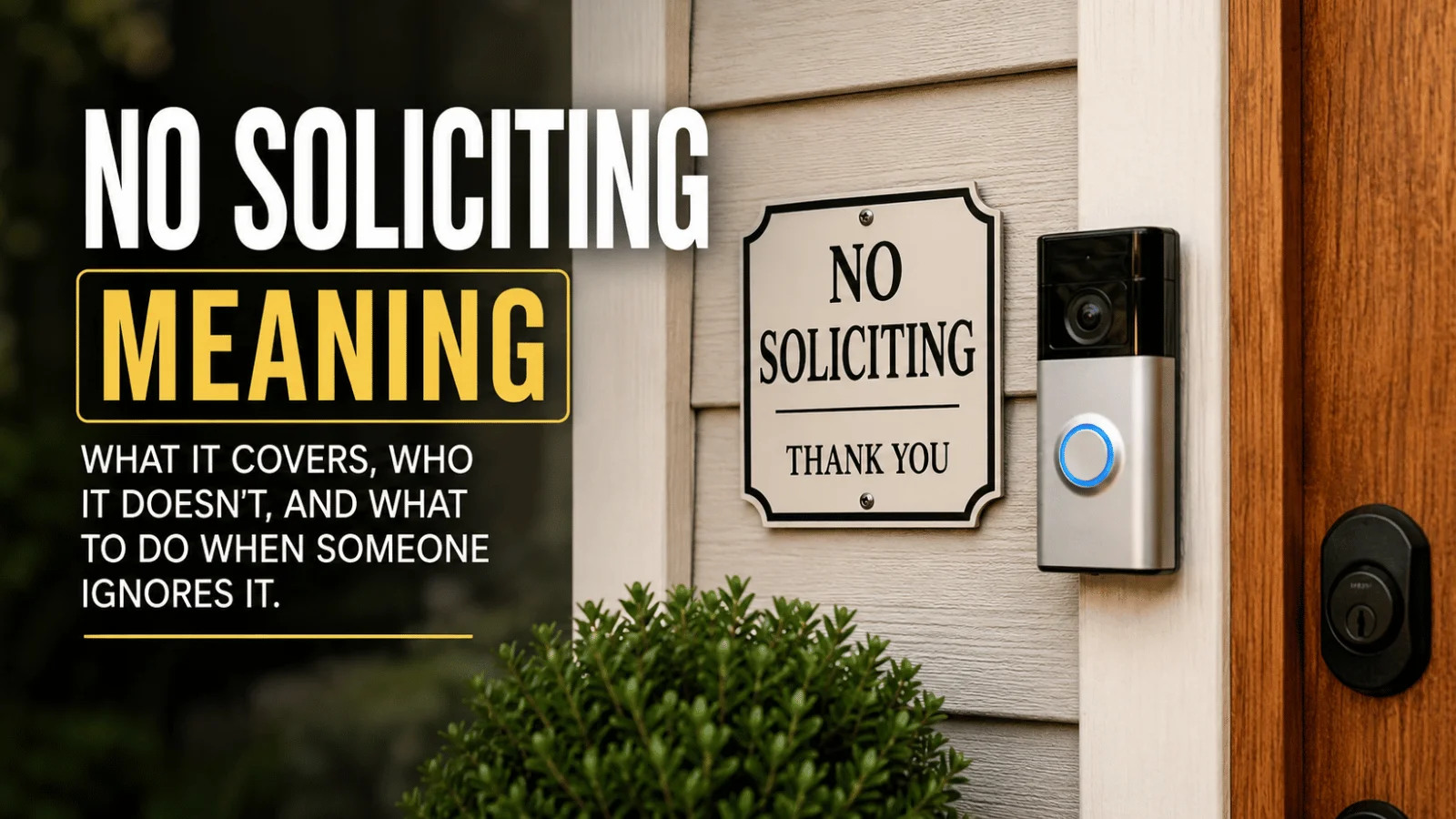
Someone stuck a small sign beside your doorbell, and you are not sure how much weight it carries. No Soliciting Meaning is stronger than most salespeople acknowledge and more limited than most homeowners believe. This guide covers what the words block, who can walk past them anyway, and what you can say at the door.
Quick Reference Table
| No Soliciting Meaning | Short answer |
| Plain meaning | Do not knock to sell, pitch, fundraise, or collect signatures. |
| Who it targets | Salespeople, canvassers, charity fundraisers, contractors hunting work |
| Who it never targets | Mail carriers, delivery drivers, meter readers, neighbours and guests |
| Legal weight | Cancels the implied invitation to approach; ignoring it can become trespassing |
| Usual exemptions | Political canvassers, religious callers, sometimes registered charities |
| If it is ignored | Ask them to leave, record details, call the non-emergency police line |
| Other places you see it | Apartment lobbies, office buildings, HOA entrances, storefronts |
| What does it do about | Sales calls, junk mail and marketing email |
Key Takeaway
- A posted sign is a refusal of permission, not a law of its own.
- It covers people asking you for money, a signature, or a contract.
- It does not cover mail, deliveries, utility crews, or your neighbours.
- Political and religious visitors usually have the right to knock once.
- Anyone who stays after you say leave has crossed into trespassing.
- Phones, mailboxes, and inboxes need separate tools entirely.
What Does “No Soliciting” Mean?
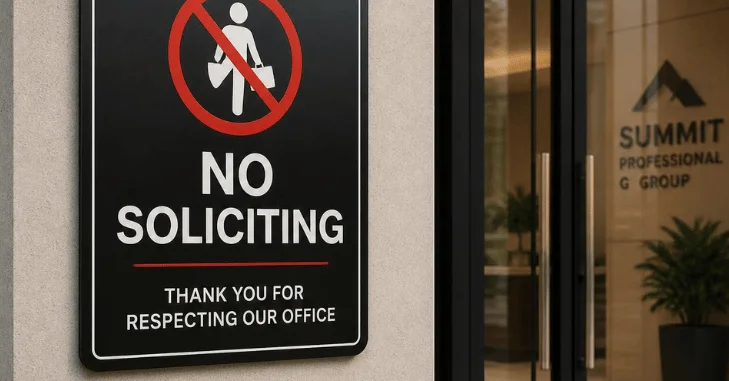
The no soliciting meaning refers to a clear request that unwanted salespeople, fundraisers, canvassers, and other solicitors do not approach a property to make a sales pitch, request money, collect signatures, or promote services. A posted sign communicates that the property owner is withdrawing the usual implied permission to approach the door for these purposes. It generally does not apply to deliveries, mail carriers, guests, utility workers, or other people visiting for legitimate non-solicitation reasons. The exact legal effect and exceptions can vary by local law, particularly for political, religious, or charitable activities.
What Counts as Soliciting at Your Door
Soliciting is asking. In doorstep terms, it means asking for money, for a signature, for your time, or for a signed agreement. The classic visitors are the solar consultant, the pest control rep, the roofer who appeared the week after a hailstorm, the alarm company closer, and the student selling magazine subscriptions. Every one of them arrived on a schedule you had no say in, and every one of them opens with a question rather than a delivery.
Charity clipboards belong in the same bucket. So do energy suppliers offering to switch your utility plan, lawn care crews leaving quotes, and anyone collecting names for a paid service. What ties them together is a stranger arriving with a commercial you never requested.
Door knocking has also become a smaller slice of how companies find customers. Most local firms now compete through search results, map listings, and review profiles instead of driveways. Running a business yourself? Our guide to local SEO and voice search for small businesses covers where those buyers look first.
What the Sign Was Never About
Plenty of people misread the sign as a general “do not knock” order.
It is not. These visitors sit outside its reach because they are not asking you for anything:
- Mail carriers and package couriers making a delivery
- Utility crews reading a meter or inspecting a line
- Government workers on official business, including census takers
- Contractors and cleaners you hired yourself
- Neighbors, friends, and anyone with a genuine reason to reach you
- Kids selling for a school team, which is a courtesy call most people allow
Here is the gap almost every explainer leaves open. The sign governs your property line and nothing else. It does not affect sales calls, junk mail, or marketing emails. For phone calls, you need the National Do Not Call Registry and your carrier’s blocking tools. For mail, you opt out through the mailing industry’s own preference services. Three channels, three separate fixes.
Is the Sign Legally Enforceable?
This is where the confusion usually sits. American law generally assumes a stranger may walk up your front path and knock once, the same way a neighbour or a delivery driver would. That assumption has a name: implied license. It is permission you never granted out loud, and you can take it back whenever you want.
Posting a sign is how you take it back in writing. Those words do not create a criminal offense in most places. What they do is remove the excuse that the visitor thought they were welcome. That matters the moment you ask someone to leave, because a person who stays on your property after a clear request is trespassing in nearly every state.
No Soliciting Versus No Trespassing
These two signs work at different ranges. No trespassing” bars everyone from the property, including the delivery driver, which is why most homes do not use it. The narrower sign blocks one category of visitor and leaves ordinary life alone. Many households post both, and that pairing gives police a cleaner story to act on.
Local rules add another layer. Many cities and counties require door-to-door sellers to register, carry a permit, and work only inside set hours. Some ordinances make it a citable violation to knock at a posted address at all. Your city clerk or licensing office can tell you which version applies where you live, and that call takes about five minutes.
Who Can Legally Ignore It
Free speech protection is the reason the sign is not absolute. Political campaigners, petition gatherers, and religious callers are generally treated as speakers rather than sellers, so a posted notice does not automatically bar them. Courts have long protected that kind of door-to-door contact as part of public debate.
That protection has a hard limit, though. It covers the approach and the first knock, not a refusal to go. Tell a canvasser you are not interested and want them off the property, and their protection ends there. Registered charities fall somewhere in between and depend heavily on local ordinances.
No Soliciting Meaning in Apartments, Offices, and HOAs
The phrase travels well beyond a front porch, and the version you meet at work is stricter than the one on a house. In an apartment building, the sign at the lobby door covers the whole shared entry, and management can bar a salesperson from the property outright. Renters also get the benefit of any clause in the lease that forbids soliciting in hallways.
Homeowners’ associations often post signs at the neighbourhood entrance. Those help, but private roads and open sidewalks complicate enforcement, so the association usually pairs the sign with a rule about permit checks. Employee handbooks use the term differently again. There, it usually bars staff from selling raffle tickets, running side businesses, or circulating fundraisers on company time. Retailers and offices post the sign to keep vendors out of the lobby. That is one reason business development moved online in the first place. A steady Injured Workers’ Guide to Navigate the Compensation Appeals reaches the same buyer without a receptionist turning anyone away.
What to Do When Someone Ignores It
Most visitors leave the second you sound certain. These steps work in order, and the first three cover almost every
Already signed something? Federal rules give buyers a three-day window to cancel most sales made at home, and many states add their own protections. That window covers a $4,000 gutter contract as easily as a $40 magazine order.
Building a Sign People Actually Obey
Wording and placement matter more than size. A canvasser scans the door for about two seconds while walking up, so the message has to land inside that window. Short beats clever. “No Soliciting. No Exceptions.” outperforms a paragraph of legal language nobody stops to read.
Put it at eye level on the door frame beside the bell, not on the mailbox, where it sits below the sightline. Weatherproof material keeps it readable through winter. A second sign at the driveway or gate makes the walk back a long one, which is often enough on its own.
Why Fewer Companies Knock Now
Pushy field sales carries a cost the sales team rarely sees. Complaints land in public reviews, on employer rating sites, and in local social groups within hours. Companies that once ran big canvassing crews now watch that feedback closely, and the smart ones treat responding to negative reviews properly as part of the job. Fewer knocks and more permission-based marketing follow from that.
Conclusion
Understanding the “no soliciting” meaning helps homeowners set clear boundaries without confusing a simple notice with a blanket ban on every visitor. A properly posted sign can withdraw implied permission for salespeople, fundraisers, and other solicitors to approach your door, while exceptions may apply to political, religious, or other protected activities depending on local law.
If someone ignores your request to leave, document the encounter and follow your local enforcement procedures. Checking city ordinances and using clear, visible wording can make the sign more effective and help prevent unwanted visits.
Apart from that, if you want to know about the article What Is a Divorce Decree? The Ultimate Guide to What It Says and How to Get It. Then, please visit our Law Category.
Your Next Step
Spend ten minutes on this today. Search your city’s website for its peddler or canvasser permit rules, then note the phone number for licensing complaints. Mount a clear sign at eye level next to the bell, and practice the one line that ends a visit. That combination handles nearly every knock you did not ask for.
Frequently Asked Questions
One core idea holds everywhere: you are withdrawing permission to approach. What changes is enforcement. Some cities fine sellers for knocking on a posted address, while others only act once you have asked the person to leave.
They work on the honest majority. Licensed crews are trained to skip posted homes because a complaint threatens their permit. Posted notices do little against scammers, which is exactly why you should never open the door to argue with one.
Usually, yes, for a single knock. Their visit is treated as a speech rather than a sale. Once you ask them to leave, staying becomes trespassing like any other visitor.
For everyday purposes, it is fine. If you want police involvement, a clearly printed and permanently mounted sign is harder to argue with later. Check your city’s rules, since a few specify wording or placement.
They are unaffected. They are completing a transaction you started, so the sign never applied to them.
It can post entrance signs and enforce rules on common property it owns. Public streets running through the community stay public, so coverage is rarely total.