
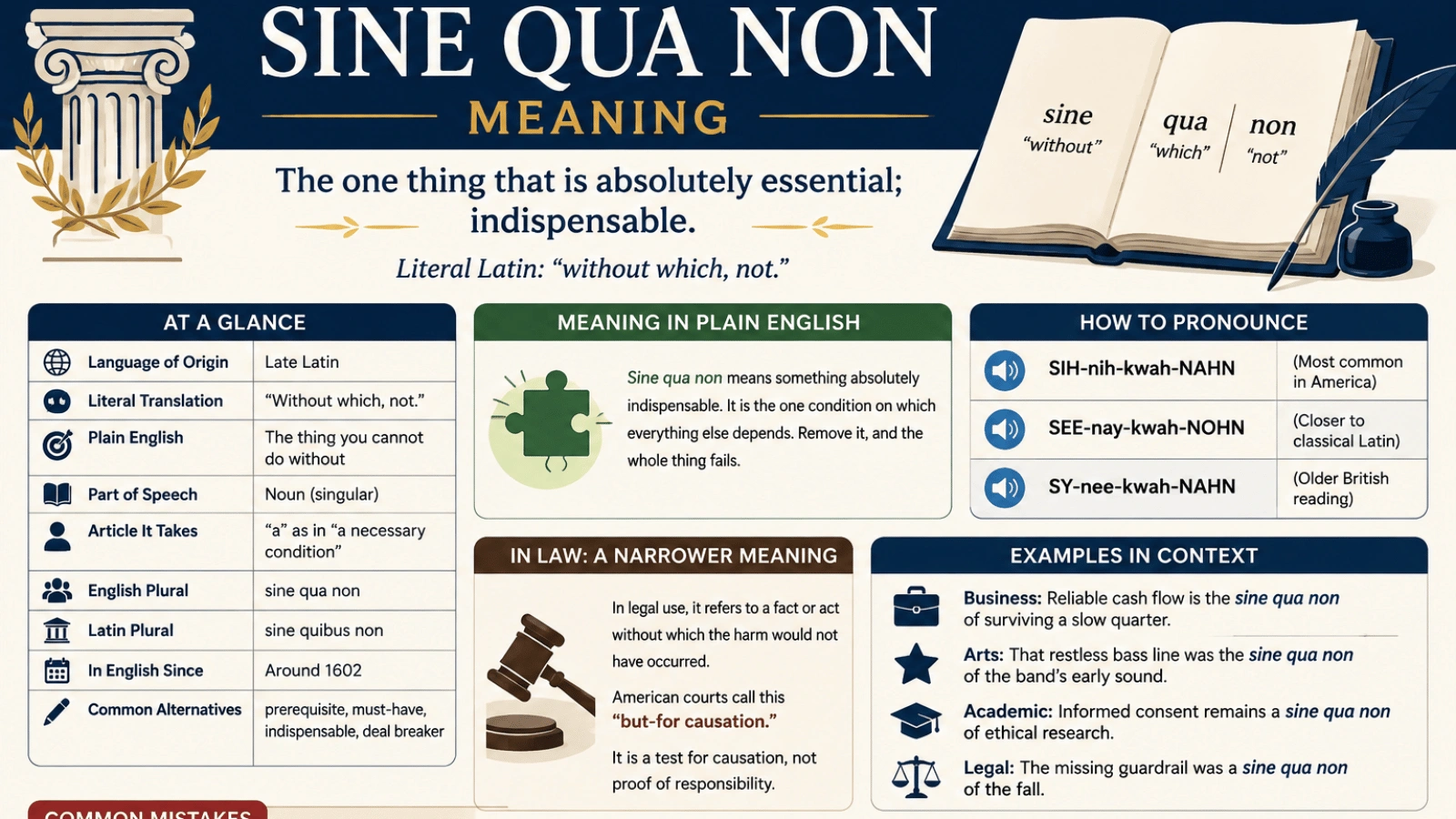
A four-hundred-year-old Latin import still turns up in Supreme Court opinions, album reviews, and quarterly board decks. The sine qua non meaning that dictionaries give is short: something absolutely indispensable. What they leave out is how to say it, how to pluralize it, and when the Latin makes you sound sharp instead of stuffy. This guide covers all three. Also worth reading: What Does Fw Mean On Text.
TL;DR
- Literal Latin: “without which, not.” The thing you cannot do without.
- Say it: SIH-nih-kwah-NAHN is the safe American reading.
- Plural: add an s in English, or use “sine quibus non” in Latin.
- Two senses: an everyday one for anything indispensable, and a narrow legal one about causation.
- Style: no hyphens, no capitals, italics optional and fading.
The phrase at a glance
| Field | Detail |
| Language of origin | Late Latin |
| Literal translation | “Without which, not” |
| Plain English | The one thing you cannot go without |
| Part of speech | Noun, treated as singular in English |
| Article it takes | “a,” as in “a necessary condition” |
| English plural | sine qua non |
| Latin plural | sine quibus non |
| In English since | Around 1602 |
| Register | Formal, literary, legal |
| Everyday swap | prerequisite, must-have, deal breaker |
Sine Qua Non Meaning in Plain English

Here is the short answer, in the form you would give a friend who asked. Sine qua non is a Latin phrase meaning something absolutely indispensable. Think of it as the one condition everything else depends on. Remove it and the whole thing collapses. English speakers use it as a singular noun, so you write “a” before it, and you say the thing it belongs to comes after “of” or “for.”
Notice the strength of the claim. Calling something important is a compliment. Calling it indispensable is a test, because you are saying the outcome cannot exist without it. Writers who use the phrase loosely spend its force on things that are merely nice to have.
Where the Latin word comes from: by word
Break it into three pieces, and it stops being mysterious. Sine means “without,” qua does the work of “which,” and non means “not.” Put them in that order, and you get the literal reading: without which, not.
That clipped shape is a legal habit. Medieval and Renaissance jurists wrote in compressed Latin formulas, and this one described a condition so necessary that its absence ended the matter. The longer version, causa sine qua non, means the cause without which the result would not have followed. English borrowed the short form around 1602 and kept it.
How to Pronounce It Without Flinching

Three readings circulate in American English, and none of them will get you corrected in a meeting.
- SIH-nih-kwah-NAHN. The most common American version and the one to default to.
- SEE-nay-kwah-NOHN. Closer to classical Latin, favoured by some academics.
- SY-nee-kwah-NAHN. The older anglicized reading, still heard from British speakers.
Stress lands on the last syllable in all three. Its middle word rhymes with “spa,” not with “day.” If you rehearse one version, make it the first. That reading carries the phrase in almost every American room.
One or Many? The Plural Question
Both plurals are correct, and they come from different systems. The English plural is sine qua non, meaning. You treat the whole phrase as one borrowed noun and add an s, the way you do with “attorneys general” gone casual. Most American editors accept it, and it reads naturally in ordinary prose.
The Latin plural is sine quibus non. That middle word changes because qua is singular and quibus is its plural form, so the Latin agrees internally instead of taking an English ending. Using it signals that you know the grammar. There is a whiff of showing off too, so save this form for scholarly writing.
The everyday sense: Essential
Outside a courtroom, the phrase means one thing: the ingredient the result cannot survive without. Critics use it for the element that defines an artist. Coaches use it for the skill a position demands. Executives use it for the capability a strategy rests on. A founder chasing a $5 million year might say it about renewals.
The pattern is simple. Name the indispensable thing, then name what depends on it. “Trust is the sine qua non of any partnership” works because trust really is load-bearing there. Swap in “enthusiasm” and the sentence deflates, because a partnership can limp along without it.
That test matters more in business writing than most word choices do, since a reader who catches one inflated claim starts discounting the rest of the page. The same discipline shows up in good content marketing for small businesses, where a single overstated promise costs more attention than it wins.
In court: The condition without which nothing happens
In law, the phrase gets narrower and more technical. In practice, Sine Qua non means it describes a fact without which the harm would not have occurred. American courts usually express the same idea in English as but-for causation: but for the defendant’s act, would this injury have happened at all?
Say a driver runs a red light and hits a cyclist. Running the light is the sine qua non of the collision, because remove it and the cyclist rides home. The test is a filter, not a verdict. A fact can pass it and still be too remote to carry responsibility, which is why courts add a second question about foreseeability.
Two things follow for a general reader. First, the legal use is about causation, not about importance, so the two senses are not interchangeable. Second, this is a general explanation of a term of art, not guidance for any particular dispute. A real case turns on its own facts and on state rules.
Four sentences you can copy

Reading the phrase in context beats memorising a definition. Here it is across four registers.
| Register | Sentence |
| Business | Reliable cash flow is the sine qua non of surviving a slow quarter. |
| Arts review | That restless bass line was the sine qua non of the band’s early sound. |
| Academic | Informed consent remains a sine qua non of ethical research. |
| Legal | The missing guardrail was a sine qua non of the fall. |
Each sentence names the indispensable item first, then the thing it supports. Copy that order. Doing so front-loads the claim you want the reader to keep. Growth writing leans on the same structure. Pitches about what a digital agency does for business growth usually open by naming the one capability everything else hangs on.
Mistakes That Give a Writer Away
These errors are mechanical and easy to avoid.
- Hyphens. Three separate words, never sine-qua-non.
- Capitals. Lowercase in running text, unless it opens a sentence.
- Italics. Optional now. American style guides increasingly set naturalized Latin in roman type.
- “An.” The first sound is a consonant, so it takes “a,” not “an.”
- Stacking. One per article. Two readings as a tic.
There is a tone risk too. Dropped into a casual message, the Latin can read as condescension rather than precision. That is the same judgment call behind a measured reply to a negative Glassdoor review, where the formal register either steadies the exchange or inflames it.
Plain English Alternatives
Sometimes the Latin costs more than it earns. These carry most of the weight:
- Prerequisite. Neutral and precise for requirements.
- Must-have. Casual, good for product and marketing copy.
- Deal breaker. Emphasizes what happens when it is missing.
- Bedrock. Warmer, works for values and principles.
- Necessary condition. The technical match, common in philosophy and law.
None of them are quite as absolute. That absoluteness is the reason to keep the original around for the rare sentence that earns it.
Your Next Step
Try the substitution test on your own writing this week. Sine Qua Non Meaning: Find a sentence where you called something critical, essential, or vital, and ask whether the result could survive without it. If the honest answer is yes, downgrade the word. If it is no, you have found a sentence the Latin has earned, and now you know exactly how to say it, spell it, and pluralize it.
Frequently Asked Questions
Something absolutely indispensable. Think of it as the condition an outcome cannot exist without.
SIH-nih-kwah-NAHN is the standard American reading, with the stress on the final syllable. SEE-nay-kwah-NOHN and SY-nee-kwah-NAHN are also accepted.
Latin. Late Latin, specifically, and it entered English writing around 1602. French borrowed it too, which is why people sometimes assume it arrived that way.
Use “sine qua non” in ordinary English. Use “sine quibus non” in scholarly writing, where the Latin plural of the middle word is expected.
It marks a fact without which the harm would not have happened; American courts call this but-for causation. On its own, it does not settle who is responsible.
There is no fixed antonym. Writers reach for “optional,” “incidental,” or “nice to have,” depending on how dismissive they want to sound.