
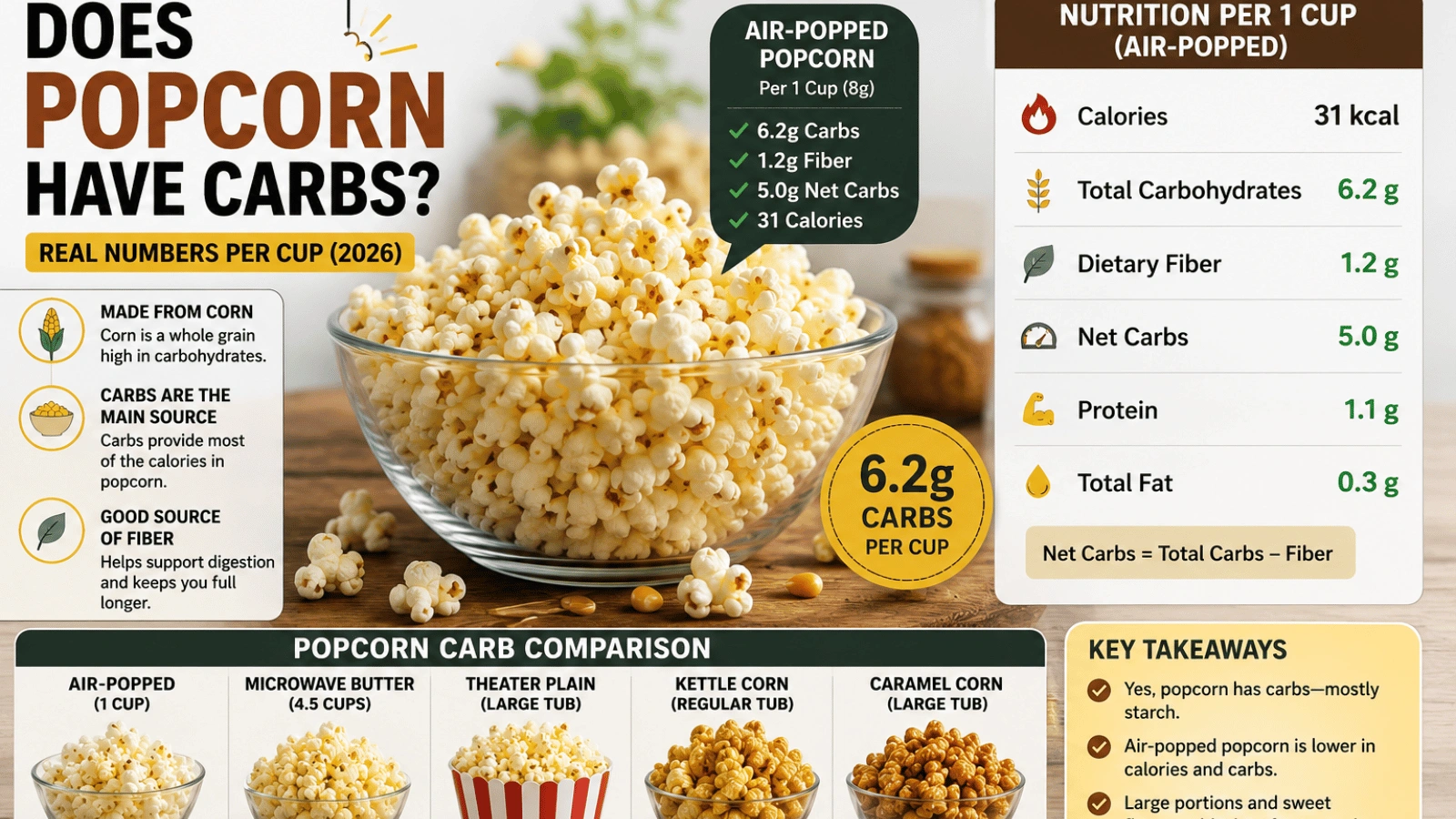
Short answer first. Does popcorn have carbs? Yes, and starch supplies almost every calorie in the bowl. A single cup of the plain air-popped kind sits closer to half a slice of bread than to a bread roll.
Quick answer: One cup of plain air-popped kernels holds 6.2 grams of total carbohydrate and 1.2 grams of Fiber. That is about 5 grams of net carbohydrate and 31 calories per serving. A standard three-cup serving comes to roughly 18.6 grams total, 3.6 grams of Fiber, and about 15 grams of net carbs.
Carb Counts at a Glance
| Type and portion | Total carbs | Fiber | Net carbs | Calories |
| Air-popped, 1 cup (8 g) | 6.2 g | 1.2 g | 5.0 g | 31 |
| Air-popped, 3 cup serving | 18.6 g | 3.6 g | 15.0 g | 93 |
| Air-popped, 100 g | 77.8 g | 14.5 g | 63.3 g | 387 |
| Microwave butter bag, 4.5 cups | 15 g | 2 g | 13 g | 160 |
| Theater small plain tub, 53 fl oz | 41 g | 8 g | 33 g | 300 |
| Theater large plain tub, 150 fl oz | 117 g | 22 g | 95 g | 870 |
| Kettle corn, regular tub | 97 g | not stated | n/a | 510 |
| Caramel corn, large tub | 404 g | 21 g | 383 g | 2,550 |
TL;DR: Plain popped corn is a carbohydrate food with a light per-cup total. Three cups sit near 15 grams of net carbohydrate. Theater tubs and sugar coatings are where the totals jump, sometimes tenfold. Portion size decides everything.
How Many carbs are in a cup?

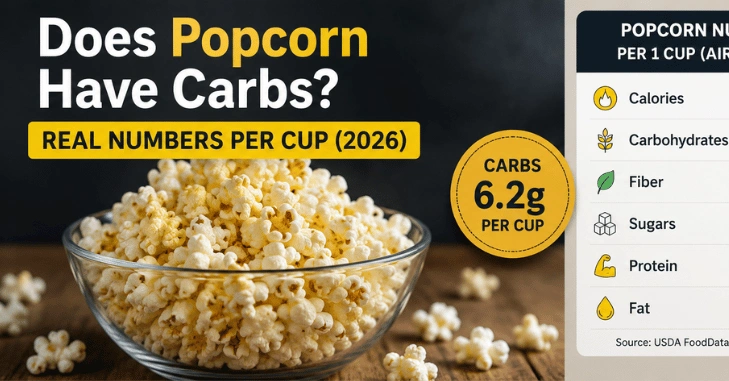
USDA FoodData Central lists air-popped kernels at 6.2 grams of total carbohydrate per cup, on an 8-gram cup weight. Fiber accounts for 1.2 grams of that. Your body treats the remaining 5 grams of carbohydrate like ordinary starch. Does Popcorn Have Carbs? Per 100 grams, the picture looks alarming: 77.8 grams of carbohydrate, 14.5 grams of Fiber, and 387 calories. That figure trips people up because no realistic serving weighs 100 grams. It would fill roughly twelve and a half cups, which is a mixing bowl, not a snack bowl.
Weight is the trick here. Popped kernels are mostly air. A cup weighs eight grams, so the per-cup number stays small even though the food is dense in carbohydrate by weight. For more on how nutrition labels mislead by portion, browse our health and nutrition explainers.
Net carbs and what the Fiber Removes
Net carbs are total carbohydrates minus Fiber. Fiber passes through mostly undigested, so low-carb eaters subtract it. That gives about 5 grams net per cup and 15 grams net for a three-cup serving. Compare that with a slice of white sandwich bread at roughly 12 to 14 grams of net carbohydrate. Whole grain corn also delivers some resistant starch, a form that ferments in the gut rather than converting to glucose quickly.
Movie Theater Tubs Are a Different Food
Theater portions break the math completely. AMC’s own nutrition statement puts a large plain tub, 150 fluid ounces, at 870 calories with 117 grams of carbohydrate and 22 grams of Fiber. Even the small tub, 53 fluid ounces, carries 41 grams of carbohydrate. Then there is caramel corn.
A large caramel tub reaches 2,550 calories and 404 grams of carbohydrate, which is more carbohydrate than most adults eat in a whole day. Kettle corn sits between the two, with a regular tub at 97 grams of carbohydrate and 510 calories. None of that is a reason to skip the movies. Share the tub, ask for the small size, or eat before you go and buy nothing. Our entertainment section has plenty of reasons to keep going.
Why Buttered Microwave Bags Read Lower Per Cup
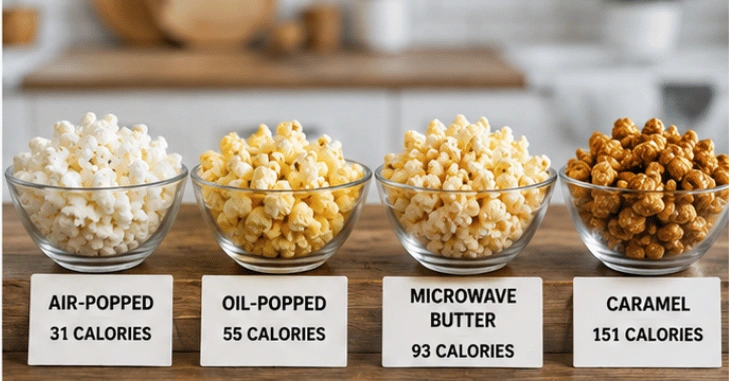
Here is the counterintuitive part. A butter-flavored microwave bag often shows fewer grams of carbohydrate per cup than plain air-popped kernels. Oil is the reason. Two tablespoons of unpopped kernels weigh 32 grams and make about 4.5 cups popped, delivering 15 grams of carbohydrate and 160 calories. Spread across those cups, that is roughly 3.3 grams of carbohydrate per cup, compared with 6.2 for the air-popped version. Fat adds calories and weight without adding a single gram of sugar or starch.
So a buttered bag is not lower in carbs in any useful sense. It is the same corn with oil poured over it, and the calorie count doubles while the carbohydrate stays flat. Bag labels catch shoppers out too. Labels usually quote kernels by weight before popping, so “2 tablespoons” on the front of a bag is really four or five cups on your lap.
Does popcorn have carbs that fit keto or a low-carb diet?
It depends on the allowance you are working with. Here is what each daily allowance buys.
| Daily carb allowance | Cups that fit (net) | Verdict |
| Strict keto, 20 g | Up to 4 cups, using the whole day’s allowance | Possible once, hard to justify |
| Low carb, 50 g | 3 to 5 cups leaves room for meals | Workable as an evening snack |
| Moderate, 150 g | 6 to 8 cups without strain | Comfortable fit |
Strict keto is the hard case. Four cups would eat the entire 20-gram allowance, leaving nothing for vegetables, dairy, or the trace carbs in everything else. Most people on that plan treat it as an occasional swap rather than a nightly habit. At 50 grams of carbohydrate a day, the snack works. Measure three cups, add salt and a little olive oil, and you have spent 15 grams of net carbs on something that fills a bowl.
Blood Sugar, Whole Grain, and the MyPlate Rule
The starch here does raise blood glucose, because starch is chains of glucose. Fiber and portion size soften the curve, and eating it with protein or fat softens it further. Anyone managing diabetes should measure a portion rather than eat from the bag, and check their own meter response, since individual reactions vary widely.
The upside is genuine. This is a whole grain, and most Americans fall short on whole grains. The USDA’s MyPlate guidance counts 3 cups of the popped snack as one ounce-equivalent of grains, and asks adults to make at least half of their daily grains whole. That same bowl carries 3.6 g of Fiber, so it does two jobs at once. That is a better trade than most snack foods offer. Chips give you refined starch and fat. This gives you Fiber, a little protein (12.9 grams per 100 grams), and a whole-grain tick.
How to keep the carb count down

- Air pop it. A hot air popper or a lidded pan with a teaspoon of oil beats any pre-buttered bag.
- Measure into a bowl. Eating from a large container is how three cups becomes nine.
- Skip sweet coatings. Caramel, toffee, and kettle glazes add sugar on top of the starch already there.
- Season with fat, not sugar. Olive oil, butter, nutritional yeast, chili powder and smoked paprika add flavor and no carbohydrate.
- Pair it with protein. A handful of cheese or some jerky alongside slows the glucose rise.
- Check the bag’s serving basis. If the label quotes unpopped kernels, multiply mentally before you trust the number.
The Bottom Line
Yes, this snack is a carbohydrate food, and no, that does not make it a problem. Six grams a cup is a modest trade for something that fills a bowl and counts toward your whole grains. Does Popcorn Have Carbs? Try this tonight: measure three cups of air-popped kernels into a bowl, season with olive oil and paprika, and log the 15 grams of net carbohydrate.
Frequently asked questions
Yes. Salt and butter change sodium and fat, not carbohydrate. Plain unsalted air-popped kernels still carry 6.2 grams per cup, since the carbohydrate comes from the corn itself.
By the usual definitions, it is a good one. Whole grain, high Fiber for its weight, minimally processed, and low in calories per cup when you leave the oil off.
About four cups of air-popped. Two cups get you to 10 grams of carbohydrate, a safer stopping point when the allowance is tight.
Cheese powders add a few grams, but caramel and kettle glazes are mostly sugar and can double or triple the total for the same volume.
Usually yes, in a measured portion, alongside protein or fat. Talk to your own clinician or dietitian about where it fits in your meal plan, because targets differ from person to person.